Renting vs. Buying Portable Cabins: Complete Financial Breakdown for Kiwis
Is Buying Really Cheaper Than Renting? Let’s Do the Maths
You’ve seen the ads. “Buy your cabin outright and stop throwing money away on rent.” It sounds smart, right up until you sit down and actually work out the numbers.
Here’s the honest truth: buying a portable cabin isn’t automatically the cheaper option, and renting isn’t automatically a waste of money either. The right choice depends on how long you need the space, how much cash you have upfront, and what you’re actually using the cabin for. Get this decision wrong, and you could end up thousands of dollars worse off than if you’d simply chosen the other path.
If you need a cabin for less than two to three years, renting almost always wins financially. If you’re planning to use it for five-plus years in one fixed spot, buying can work out cheaper over time, but only once you factor in delivery, consent costs, maintenance and the fact that cabins lose value the moment they’re dropped on-site. For flexibility, low upfront cost and zero maintenance headaches, renting a cabin from Room2Rent is usually the smarter move for most Kiwis.
Key Takeaways
- Buying a portable cabin costs $15,000–$40,000+ upfront, plus delivery, site prep and ongoing maintenance.
- Renting spreads the cost over time with little to no large deposit required.
- Buying only pays off if you’re staying put long-term with spare capital to invest.
- Renting removes maintenance, depreciation and resale risk entirely.
- Room2Rent’s Standard, Large and Extra Large cabins suit different budgets and space needs.
- Flexibility matters: renting lets you adjust as your life or business changes.
What This Comparison Actually Covers
A portable cabin is a small, ready-made building that gets delivered straight to your property. No months of consent battles, no builders traipsing through your garden for half a year. People use them as home offices, sleepouts, beauty studios, staff rooms, or simply extra space when the house feels too small.
The big decision most people face isn’t whether they want a cabin. It’s whether they should rent one or buy one outright. Both paths get you the same result, a usable extra room, but they get you there through completely different financial routes. This guide walks you through the real costs of each option, so you can see exactly where your money goes and choose with confidence.
The True Cost of Buying a Portable Cabin
Buying feels satisfying because you own something at the end of it. But ownership comes with a price tag that goes well beyond the sticker price.
Upfront capital. A new portable cabin typically costs anywhere from $15,000 to $40,000 or more, depending on size and fit-out. You need this money ready to go, either in savings or through a loan that comes with its own interest costs.
Delivery and site preparation. Getting a cabin onto your property isn’t free. You’ll often need a level base, crane or truck access, and sometimes consent from your local council depending on the cabin’s size and how long it stays put. These costs can add several thousand dollars before the cabin has even been used once.
Depreciation. Like a car, a cabin loses value the moment it’s delivered and used. If your circumstances change and you need to sell it, you’ll rarely recover what you paid, especially once wear and tear sets in.
Maintenance and repairs. You own it, so every leak, hinge, and repaint is your responsibility and your cost. Over five or ten years, this adds up quietly in the background.
Reduced flexibility. If you move house, change jobs, or simply don’t need the space anymore, you’re stuck either transporting a heavy structure or selling it at a loss. Buying locks you into a decision that’s hard to reverse.
The True Cost of Renting a Portable Cabin
Renting flips the entire equation. Instead of one large payment, you pay a manageable amount over time, and someone else carries the risk.
Lower upfront cost. Renting a cabin from a provider like Room2Rent means no five-figure payment before you’ve even used the space. You pay to use it, not to own it outright, which frees up cash for everything else life throws at you.
No maintenance burden. If something needs fixing, that’s on the provider, not you. This alone can save hundreds of dollars a year, plus the hassle of finding a tradesperson.
Built-in flexibility. Life changes. Renting means you’re not tied to a structure you no longer need. Whether you’re using it as a home office for remote work for six months or a backyard privacy space for a couple of years, you can adjust as your circumstances shift.
No depreciation risk. You never have to worry about resale value, because you never owned the asset in the first place. That risk sits with the provider.
Simple, predictable costs. Rental agreements usually come with clear, fixed terms, so you know exactly what you’re paying each month without any nasty surprises. This is one of the financial benefits of long-term cabin hire that often gets overlooked.
Rent vs. Buy: The Five-Year Cost Snapshot
Numbers tell the story better than opinions do. Here’s a simplified look at how the two options tend to compare over five years for a standard-sized cabin.
| Cost Factor | Buying a Cabin | Renting a Cabin |
| Upfront payment | $15,000–$40,000+ | Little to no large deposit |
| Delivery & site prep | $2,000–$6,000 | Usually included |
| Ongoing maintenance | Your responsibility | Covered by provider |
| Flexibility to relocate or return | Low, costly to move | High, simple returns |
| Resale/depreciation risk | Yours to carry | None |
| Total 5-year outlay (approx.) | $20,000–$45,000+ | Predictable ongoing rental cost |
The exact figures shift depending on cabin size and how long you keep it, but the pattern holds true across the board: buying asks for more money sooner, while renting spreads the cost and removes the guesswork.
When Buying Actually Makes Sense
Buying isn’t wrong for everyone. If you own land long-term, have the cash sitting ready, and know for certain you’ll use the cabin for many years without moving, ownership can eventually pay for itself. Businesses that need a permanent staff room or storage solution on a site they’ll occupy indefinitely sometimes find buying works in their favour too.
But this only holds up under specific conditions: no plans to move, no need for flexibility, and enough spare capital that tying it up in a depreciating structure doesn’t hurt your wider finances.
When Renting Is the Smarter Choice
For most Kiwis, renting wins out. If you’re not certain how long you’ll need the space, if cash flow matters more than ownership, or if you simply don’t want the hassle of maintenance and resale, renting removes the risk entirely.
Room2Rent offers three cabin sizes to suit different needs, so you’re not paying for space you don’t use:
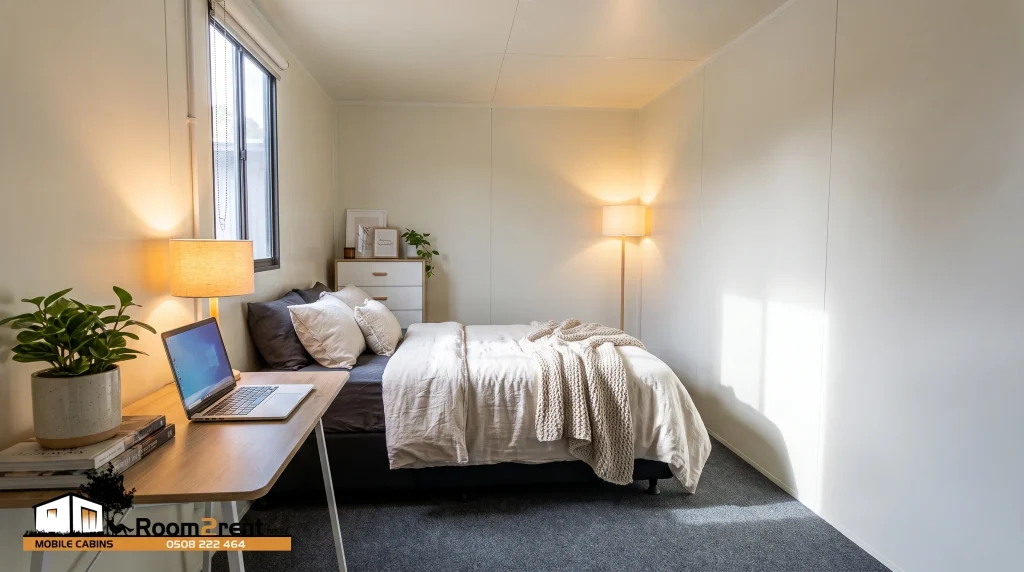
- The Standard Cabin suits one person, with room for a queen bed, a desk and drawers, ideal as a home office, beauty studio or small sleepout.
- The Large Cabin fits a king or queen bed with a small sitting area, perfect for singles, couples, or as a shared space for kids.
- The Extra Large Cabin has room for a queen bed, two singles, and drawers, popular with businesses wanting to house multiple staff or desks in one spot.
Whichever size suits your situation, you can compare options and pricing on the Room2Rent cabins page without committing to a large upfront cost.
Key Benefits of Renting Instead of Buying
Choosing to rent rather than buy isn’t just about saving money today. It changes how you approach the whole decision, giving you room to adapt rather than locking you in.
You get access to a quality cabin without draining your savings. You avoid the stress of maintenance, repairs and eventual resale. You can scale up or down as your needs change, whether that’s a growing family, a new business venture, or simply wanting extra space for a season. And because Room2Rent handles delivery and set-up, you skip the logistics headache too, you can read more about how that delivery process works before you commit.
If you’ve weighed up renovating instead, it’s worth comparing that path too. Many Kiwis find that portable cabins work out far more practical than renovations, especially when time and disruption are a concern.
Ready to Compare Your Options with Room2Rent?
The numbers don’t lie: for most people, renting a portable cabin makes more financial sense than buying one outright. You get the space you need without the debt, the depreciation, or the maintenance bills that come with ownership.
If you’re ready to see what fits your situation, get in touch with the Room2Rent team for a no-pressure chat about your options. You can also browse cabins available in your region, check out the full FAQ page for common questions, or read up on common mistakes to avoid when renting a cabin before you sign anything.
The Bottom Line on Renting vs. Buying
There’s no single right answer here, only the right answer for your situation. If certainty, permanence and long-term land ownership are part of your plan, buying might eventually work in your favour. But for most Kiwis dealing with changing circumstances, tight budgets, or simply wanting a straightforward solution without the ongoing responsibility, renting a portable cabin is the more sensible, lower-risk choice.
Before you commit either way, it’s worth running your own numbers against your specific timeline. And if you’d like a second opinion, the team at Room2Rent are happy to talk through what would work best for you.
Frequently Asked Questions
Renting is usually cheaper if you need the cabin for under three years, since you avoid the large upfront cost, maintenance and depreciation that come with buying. Buying can work out cheaper only over many years of continuous use on land you own long-term.
A new portable cabin in New Zealand typically costs between $15,000 and $40,000 or more, depending on size, fit-out and features. This doesn’t include delivery, site preparation or ongoing maintenance costs.
It depends on how long the cabin stays and how it’s used. Many rental cabins fall under exemptions for temporary structures, but it’s worth checking your local council rules. Room2Rent can guide you through what applies to your situation.
You simply return it to the provider once your rental term ends. There’s no need to sell it, transport it, or worry about losing money on resale, which is one of renting’s biggest financial advantages.
Yes, portable cabins are a popular choice for remote workers because they create a separate, quiet space away from household distractions without the cost of a full home extension or renovation.
Delivery timeframes vary by provider and region, but portable cabins are generally much faster to arrange than a traditional build or renovation, often within weeks rather than months.
Absolutely. Many Kiwis use portable cabins as sleepouts for teenagers, guests, or extended family, offering private space without the cost of building a permanent addition to the house.
With a rental agreement, the provider typically covers maintenance and repairs, meaning you don’t need to budget for unexpected costs like leaks, hinges or general wear and tear.
Yes, businesses often rent cabins for staff rooms, temporary offices or extra workspace, since it avoids tying up capital in an asset that may not suit future needs as the business grows or changes.
It depends on your use. A Standard Cabin suits one person, a Large Cabin suits couples or small families, and an Extra Large Cabin suits businesses or larger households needing more room to move.