How Much Power Does a Portable Cabin Use? (Weekly Costs Worked Out)
QUICK ANSWER
Portable cabin power usage is mostly heating. Lights, a laptop, phone charging and a kettle use about 5 kWh a week, roughly $2 at 39.3c/kWh. Add a heater for winter evenings and an insulated Standard cabin typically costs around $8 a week to run; an uninsulated one could cost nearly three times that.
KEY TAKEAWAYS
- A portable cabin’s everyday appliances (LED lights, laptop, phone charger, kettle, electric blanket) use around 5 kWh a week, or about $2 at the 2026 NZ average power price of 39.3c/kWh.
- Heating is the biggest driver of cabin electricity cost per week: a 2,000W plug-in heater costs about 79 cents for every hour it runs flat out.
- In our modelled example, an insulated 3.6m Standard cabin heated five hours each winter evening costs about $8 a week in total; an uninsulated cabin of the same size costs about $23.
- Running cost formula: watts ÷ 1,000 × hours × price per kWh = cost. Your own price per kWh is printed on your power bill.
- A Room2rent cabin plugs into a standard household socket, so its power use shows up on the host property’s bill — with no extra daily connection charge.
- A standard 10-amp socket supplies roughly 2,300W, so avoid running a large heater and a kettle off the same circuit at the same time.
Why the power bill question matters before the cabin arrives
You’ve found the space for a cabin — at the back of the section, beside the garage, or on a corner of the lifestyle block — and you know what it costs to rent. Then a second, quieter question comes up: what is it going to add to the power bill?
That question matters more than most people expect. For a family adding a bedroom for a teenager, a household on a tight budget, or someone working from home five days a week, a power bill surprise in July can undo the savings that made the cabin a good idea in the first place. Understanding portable cabin power usage before delivery day lets you plan for it, split it fairly, and avoid the habits that quietly push it up.
This guide does the maths. We work through what common appliances use in kilowatt-hours (kWh), price them at the average New Zealand tariff, and show how much difference insulation makes to the one appliance that really counts: the heater.
What does “portable cabin power usage” actually mean?
Portable cabin power usage is the amount of electricity a cabin draws through its power lead, measured in kilowatt-hours (kWh), the same unit your retailer bills you for. One kWh is a 1,000-watt appliance running for one hour.
A Room2rent cabin comes with LED lights inside, an outdoor security light, two double power outlets and an RCD-protected switchboard with an electrical safety certificate. It connects with a 20-metre lead that plugs into a regular three-pin socket at the house — the setup itself is covered in our guide to power and water setup for a portable cabin rental. Because the cabin runs off the house supply, everything used inside it is metered on the host property’s account.
How do you work out what an appliance costs to run?
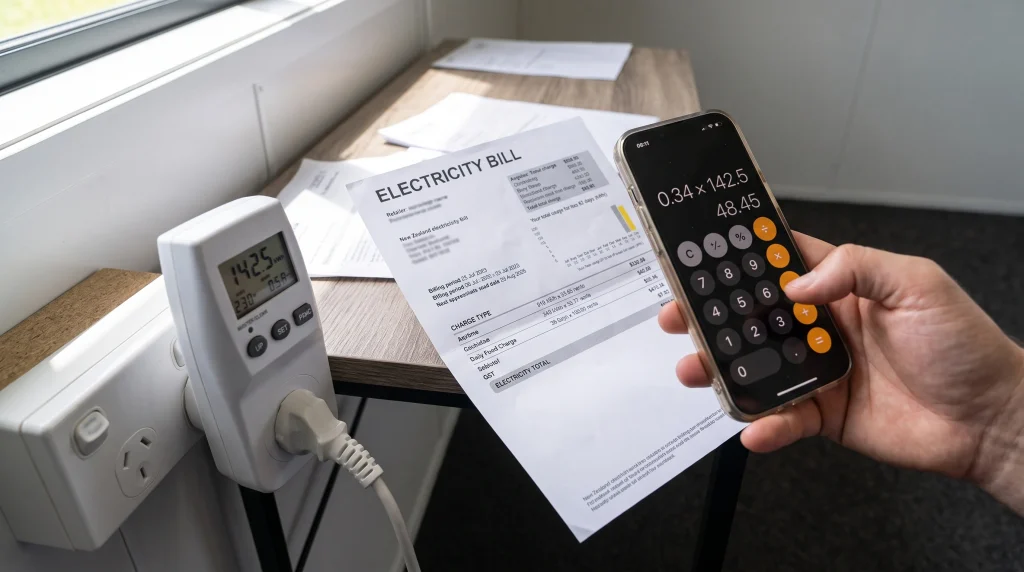
Multiply the appliance’s wattage (divided by 1,000) by the hours it runs, then by your price per kWh. That gives you the cost in dollars.
The formula looks like this:
Watts ÷ 1,000 × hours used × price per kWh = running cost
For example, a 2,000W heater running for three hours uses 2 × 3 = 6 kWh. At 39.3c/kWh that’s about $2.36. You’ll find the wattage on the appliance’s label or packaging, and your price per kWh on your power bill.
What price per kWh should you use?
For a quick estimate, use 39.3 cents per kWh — the national average from MBIE’s February 2026 price survey. Your actual rate depends on your region, retailer and plan.
MBIE’s survey shows prices ranging from around 35c/kWh in the cheapest centres, such as Wellington, to nearly 49c/kWh in the most expensive parts of the lower South Island. The survey’s average also spreads the daily fixed charge across every unit used, which makes it a slightly conservative number for a cabin. Because a cabin shares the house’s existing connection, it adds no extra daily fixed charge — only the per-kWh usage charge. If the usage rate on your bill is closer to 30c, your real costs will be around a quarter lower than the figures below.
How much power do lights, a laptop and a kettle use?
Everyday cabin appliances use very little — about 5 kWh a week, or roughly $2. It’s the heater that changes the picture.
Here’s a typical week for one person using a cabin as a bedroom or study. Wattages are typical figures; check your own appliances’ labels.
| Appliance | Typical wattage | Daily use | kWh per week | Cost per week at 39.3c |
| LED lighting (cabin interior) | 30W | 5 hours | 1.05 | $0.41 |
| Laptop | 60W | 4 hours | 1.68 | $0.66 |
| Phone charging | 10W | 3 hours | 0.21 | $0.08 |
| Electric blanket (pre-warm) | 100W | 1 hour | 0.70 | $0.28 |
| Kettle | 2,200W | 2 boils of ~3 min | 1.54 | $0.61 |
| Total (no heating) | 5.18 | $2.04 |
A kettle draws a lot of power but only for a few minutes, so it barely registers across a week. A laptop runs for hours but at low wattage. Neither is where a cabin’s power bill comes from.
How much does it cost to run a heater in a sleepout?
A plug-in heater costs roughly 39 cents an hour per 1,000 watts while it’s running at full output. A thermostat that cycles the heater on and off lowers the real figure.
| Heater size | Cost per hour at full output (39.3c/kWh) |
| 1,000W | $0.39 |
| 1,500W | $0.59 |
| 2,000W | $0.79 |
| 2,400W | $0.94 |
Every plug-in electric heater — panel, oil column, convector or fan — turns one unit of electricity into one unit of heat. What changes your sleepout heater running cost isn’t the heater type so much as how many hours it has to run, and that depends on how fast the cabin loses heat. If you’re still choosing which heater to use, our guide to heating options for portable cabins in a NZ winter compares them; this post focuses on what they cost to run.
Insulated vs uninsulated: how much does it change the weekly cost?
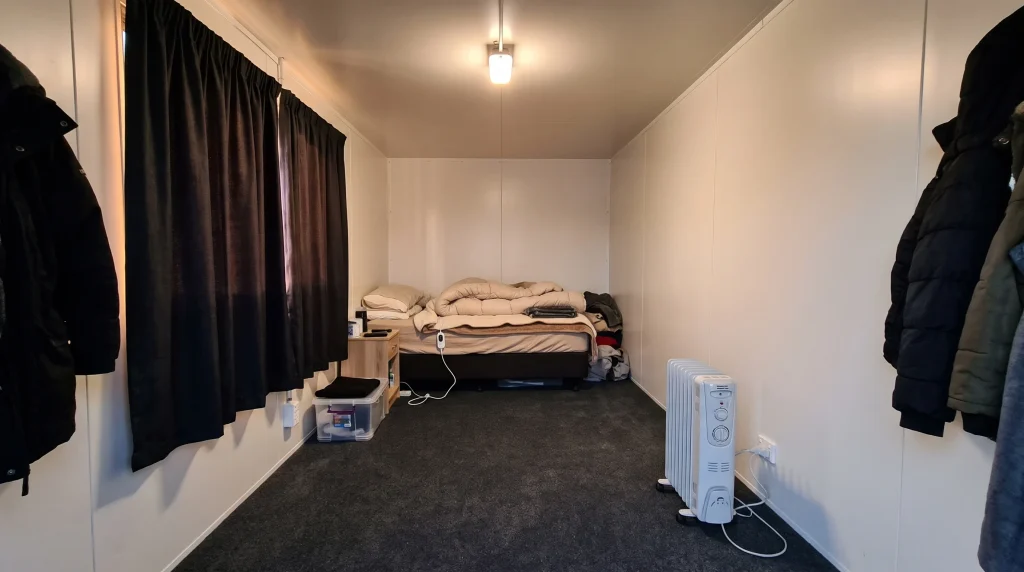
In our modelled example, an uninsulated cabin needs more than three times as much heater power to stay at the same temperature as an insulated one. Over a winter week, that’s the difference between about $8 and about $23.
To show the effect, we modelled a Standard-sized cabin (3.6m × 2.4m × 2.4m) kept 12°C warmer than outside — say 18°C inside on a 6°C evening. We compared two versions: one with insulated walls, ceiling and floor, double glazing and good draught sealing; and one with thin uninsulated panels, single glazing and draughty joints. These are estimates from standard heat-loss calculations, not meter readings, but they show the scale of the difference clearly:
- Insulated cabin: needs an average of about 450W of heat to hold temperature.
- Uninsulated cabin: needs an average of about 1,500W — a 2,000W heater would be working flat out much of the time.
Here’s what that looks like per week, including the $2 of everyday appliances above:
| Usage pattern (one week) | Insulated cabin | Uninsulated cabin |
| Summer — no heating | ~$2 (5 kWh) | ~$2 (5 kWh) |
| Winter evenings — heater 5 hours a day | ~$8 (21 kWh) | ~$23 (58 kWh) |
| Home office — heater 8 hours, 5 weekdays | ~$9 (23 kWh) | ~$26 (66 kWh) |
| Winter evenings plus overnight — heater 13 hours a day | ~$18 (46 kWh) | ~$56 (143 kWh) |
Modelled estimates at 39.3c/kWh. Real costs depend on your local climate, thermostat setting, cabin position and power plan.
The pattern holds across every scenario: insulation roughly cuts the heating part of the bill by two-thirds. That’s why the walls, ceiling and floor matter more than which brand of heater you buy. Our article on whether a sleepout is warm enough for a NZ winter explains the building side of this in more detail.
Does cabin size change the running cost?
Yes, but less than insulation does. A larger cabin has more air to warm and more wall and roof area losing heat, so it needs a little more heating to hold the same temperature.
Room2rent cabins come in three sizes: Standard (3.6m long), Large (4.2m) and Extra Large (4.8m), all 2.4m wide and 2.4m high. Going from a Standard to an Extra Large adds about a third more floor area, so expect the heating portion of the bill to rise by a similar proportion — perhaps $2 to $3 a week extra on an insulated cabin used on winter evenings. If the extra space isn’t needed, a smaller cabin is the cheaper one to keep warm.
What are the safety limits on a cabin’s power supply?
A standard New Zealand 10-amp socket can safely supply about 2,300W in total. Everything running in the cabin at the same moment has to fit within that.
That’s plenty for lights, a laptop, a phone, an electric blanket and a 1,500W–2,000W heater together. Where people run into trouble is boiling a 2,200W kettle while a 2,000W heater is also on — together that’s well over the limit and may trip the RCD or overload the circuit. A few simple habits keep things safe:
- Size the heater to the cabin. An insulated Standard cabin rarely needs more than 1,500W–2,000W.
- Turn the heater down before using the kettle, or boil the jug in the house.
- Plug in only one heater per socket, as EECA’s Gen Less advice recommends.
- Don’t add extra extension leads or multi-boxes to the cabin’s own lead.
- Check which socket at the house the cabin lead uses, and avoid sharing that circuit with a heater or dryer in the house itself. Ask your Room2rent team if you’re unsure.
Who pays for the cabin’s power?
Because the cabin plugs into the house, its electricity goes on the host property’s bill. If the person using the cabin isn’t the account holder, it’s worth agreeing how to split it before winter.
This comes up often. A family adding a sleepout for a teenager may just absorb it. But if the cabin is housing a relative, a boarder, someone in a housing transition, or a staff member on a business site, a clear agreement avoids awkward conversations later. Using the weekly figures above is a fair starting point — for example, 8–10 a week in winter for an insulated cabin used in the evenings, dropping to around $2 in summer. A cheap plug-in energy monitor between the lead and the house socket lets you split the actual usage instead of an estimate.
How to keep cabin electricity costs down
Most of the savings come from running the heater for fewer hours. These habits make the biggest difference:
- Use a thermostat and timer. A heater that switches off once the cabin is warm costs far less than one running flat out all evening.
- Warm the cabin before you go in, not all day. A timer set 20–30 minutes ahead is enough in a well-insulated space.
- Keep the door shut and close the curtains at dusk. Windows lose more heat than insulated walls.
- Use an electric blanket for bedtime warmth. At around 100W, it costs a fraction of heating the whole room overnight.
- Manage moisture. A damp room feels colder than it is, which tempts you to turn the heater up. Brief ventilation through the day helps.
- Turn things off at the wall when the cabin is empty for days at a time.
As we head into summer, heating drops out of the equation altogether and most cabins cost only a couple of dollars a week to run. Keeping the space comfortable then is more about shade and airflow — see our tips on keeping a portable cabin cool in a NZ summer.
What we see at Room2rent
In our experience at Room2rent, the cabins that cost the least to run aren’t the ones with the fanciest heater. They’re the ones where the insulation is doing the work, the heater is sized to the room and on a thermostat, and the household has agreed up front how the power gets shared. That’s why every Room2rent cabin is built with full thermal insulation as standard, along with LED lighting and an RCD-protected switchboard with an electrical safety certificate — so the cheapest kWh is the one you never have to buy.
Plan your cabin’s running costs before delivery
Portable cabin power usage is predictable once you break it down. Everyday appliances add about $2 a week. Heating is the variable, and insulation decides whether a winter week costs around $8 or more like $23. Use the formula, check the rate on your own bill, and you’ll know what to expect before the cabin arrives.
If you’re comparing sizes or want to talk through heating and power for your section, browse the Room2rent cabin range or get in touch with your local Room2rent team. We’ll help you choose a fully insulated cabin that suits how you’ll use it — and keeps your power bill under control.
Frequently Asked Questions
Without heating, a cabin used as a bedroom or study typically uses well under 1 kWh a day for lighting, a laptop, phone charging and a kettle. With a plug-in heater running on winter evenings, an insulated Standard cabin might use around 3 kWh a day, while an uninsulated one could use 8 kWh or more for the same comfort.
It can be, because a well-insulated cabin is a small, sealed space with less air to warm than many older New Zealand bedrooms. An uninsulated cabin, though, loses heat quickly and can cost more to heat than a house room. The insulation standard matters more than whether the room is attached to the house.
At full output, a 2,000W heater uses 2 kWh an hour, so eight hours costs about $6.30 at 39.3c/kWh. With a thermostat in an insulated cabin, it cycles off once the room is warm, so real overnight costs are usually much lower. An electric blanket is a cheaper alternative for overnight warmth.
A Room2rent cabin connects to the house supply through a power lead rather than having its own retailer meter, so its usage is billed on the host property’s account. If you want to track exactly what the cabin uses, a plug-in energy monitor fitted between the lead and the house socket gives you a running kWh total.
Heat pumps are the most efficient electric heating, but they need fixed installation and an outdoor unit, which usually isn’t practical on a rented, relocatable cabin. Most renters use a thermostat-controlled panel or oil column heater instead. Check with your rental provider before arranging any fixed installation.
No. Because the cabin plugs into your existing household supply, it adds only to the kWh you use, not to your daily fixed charge. However, your total usage could affect which plan suits you best, especially as low-user plans change, so it’s worth comparing plans on Powerswitch once you know your new usage.
A home office running a laptop, monitor and lights all day uses relatively little. The heater is the main cost. In our modelled example, heating an insulated Standard cabin for eight hours a day, five days a week, plus everyday appliances, comes to about 23 kWh or roughly $9 a week.
The usual causes are a heater running more hours than expected, a heater without a thermostat running flat out, or heating an empty cabin during the day. Check the heater’s wattage and how long it’s on, then use the formula watts ÷ 1,000 × hours × price per kWh to see where the cost is coming from.
Not per hour — any plug-in electric heater of the same wattage uses the same electricity while running. Fan heaters warm a room quickly for short bursts, while oil column heaters release heat more evenly. The cheaper option is whichever runs fewer hours to keep you comfortable, ideally on a thermostat.
Very little. With no heating, a cabin’s lights, devices and kettle typically use around 5 kWh a week, which is about $2 at the 2026 national average price. Costs only rise in summer if you add cooling, such as a fan, which still uses far less power than a heater.