Portable Cabin Rental Quality: How to Check It Before You Sign
Photos Can’t Tell You How a Cabin Feels at 6am
Two rental cabins can look exactly the same online. One is warm, dry and quiet. The other has a cold floor, a musty corner and a power point that doesn’t work. The photos won’t show you which is which.
That’s the honest problem with renting a portable cabin: quality is hard to see from a screen. The good news is that you can test it yourself. With a few documents to ask for, a ten-minute walk-through and a couple of simple checks in your first week, you can find out how good a cabin really is. You don’t need any building knowledge to do it.
Judge portable cabin rental quality with proof, not promises. Ask to see the electrical safety certificate, get the insulation details in writing, walk through the cabin on handover day, and test it during your first week. Room2rent Mobile Cabins is happy to answer these questions before you commit, and you can see what comes as standard.
Key Takeaways
- Judge quality with proof on paper, in person, over time and in the level of care.
- Ask to see the electrical safety certificate and confirm the RCD switchboard.
- Get insulation details, including the R-value, in writing.
- Do a ten-minute walk-through on handover day, and take dated photos.
- Test the cabin for a week and report problems early.
- Make sure you know who to call and how the rental ends.
What Does Portable Cabin Rental Quality Really Mean?
A portable cabin is a ready-built room that arrives on a truck and is set up on your property in days. Quality is simply how well that room does its job once you’re living or working in it. Does it stay warm and dry? Is it safe to sleep in? And does the company behind it look after you, from delivery day to collection day?
You can check all of this in four ways. Proof on paper means the certificates and written details. Proof in person means what you can see and test on handover day. Proof over time means how the cabin behaves in the first few weeks, and what past renters say. Proof of care means how the company treats you when you need help, or when the rental ends. We’ll take each one in turn.
Still choosing a size or setting a budget? Our guide on how to pick the right portable cabin is the better place to start. This guide is for after you’ve narrowed it down and want to know whether a particular cabin is any good.
What questions should I ask before renting a portable cabin?
Ask these three first: does my site need council consent, what is the minimum rental term, and how will power and water be set up? Get the answers in writing before you pay anything, because these three catch out more new renters than anything else.
Beyond the Big Three: Your Proof Checklist
Once those are covered, use the table below to ask for proof rather than promises. Each row shows what to ask for and what should make you pause.
| Ask about | Ask to see or hear | Pause if you hear |
| Electrics | A copy of the electrical safety certificate, and confirmation of an RCD switchboard | “It’s all been checked,” with nothing to show you |
| Insulation | Which parts are insulated (roof, walls, floor) and the R-value, in writing | “It’s fully insulated,” but no details |
| Weather sealing | The cladding material, and how the joins and roof are sealed | Vague answers, or a refusal to send close-up photos |
| This exact cabin | Recent photos of the actual cabin you’ll receive | Only stock photos |
| Safety extras | A working smoke detector and an outdoor security light | Anything “to be added later” |
| Past renters | Feedback from earlier renters, or a short chat with one | No feedback anywhere |
| Help | Who to call if something goes wrong, and how quickly they reply | No name or number |
| The ending | How much notice you give to return it, and whether collection is included | Unclear exit terms |
Take this table to your first phone call. A good provider will answer most of it on the spot, and will happily send the rest.
Proof on Paper: What to Ask to See
Paperwork sounds dull, but it’s the quickest way to tell a careful provider from a careless one. Three documents matter most.
The Electrical Safety Certificate and RCD
Electricity is the one area where “trust me” isn’t good enough. Ask for a copy of the electrical safety certificate, and check that it belongs to the cabin you’re getting. Then ask about the RCD switchboard. An RCD (residual current device) is a safety switch that cuts the power in a fraction of a second if something goes wrong. Room2rent cabins come with both, so you should expect the same from anyone you rent from.
Insulation Details You Can Check
“Fully insulated” is easy to say. What you want is detail. Ask which parts of the cabin are insulated, and ask for the R-value in writing. R-value is a score for how well a material stops heat moving through it, and higher is better. Room2rent cabins come with full thermal insulation, and you can read more about how it works in our portable cabin insulation guide. If a provider can’t give you specifics, treat that as useful information.
Cladding, Roofing and Weather Sealing
Cladding is the outer skin of the cabin, and it’s your first line of defence against rain. Ask what it’s made from. Then ask for close-up photos of the corners, the roof edge and the base of the walls, because that’s where water tends to sneak in. Sharp, clear photos are a good sign. Our guide on preventing damp in a portable cabin explains why these spots matter.
Proof in Person: Your Ten-Minute Handover Walk-Through
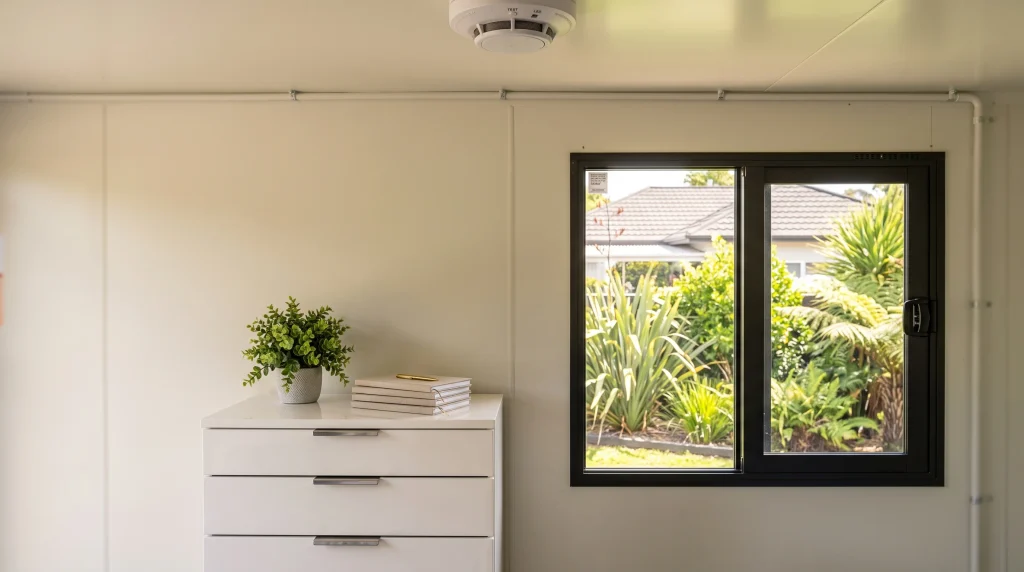
The day your cabin arrives is your best chance to check its quality. Do it while the delivery team is still on site. Bring a torch, a phone charger and your phone camera.
| What to check | How to test it | What good looks like |
| Floor | Walk the full length and stand in each corner | Firm and level, with no soft or bouncy spots |
| Walls and ceiling | Run your torch along them | No stains, ripples or peeling |
| Door and windows | Open, close and lock each one, then look for daylight around the frames | Smooth, snug and gap-free |
| Power points | Plug your charger into every outlet (Room2rent cabins have two double outlets) | Every socket works |
| RCD | Press the test button on the switchboard | The power cuts off, then returns when you reset it |
| Smoke detector | Press the test button | A loud, clear alarm |
| Lights | Switch on the inside LEDs and the outdoor security light | All work, with no flicker |
| Smell | Stand inside with the door shut for a minute | Fresh, with no musty odour |
| Step and entry | Use the outside step and open the door | Steady, with no wobble |
Two extra tips will save you trouble later. First, take dated photos of every wall, the floor, the ceiling and the switchboard before you unpack, and send them to your provider the same day. Second, if anything isn’t right, say so before the delivery team leaves. That way it’s on record from day one. Curtain tracks are already fitted in Room2rent cabins, so you only need to bring the curtains.
Proof Over Time: What the First Week Tells You
Run a Simple First-Week Test
Some problems only show up after a few days. So for your first week, jot a quick note on your phone each morning and evening. Write down how the cabin feels, whether the windows have fogged up, and whether you can smell damp when you first open the door.
A well-made cabin stays steady. It shouldn’t swing from freezing to stuffy in a day. Heavy condensation, a cold floor or a musty smell are all early warnings, and you should report them straight away. If it’s simply chilly, a small heater often does the job, and our winter heating guide has ideas.
What Real Renters Say
Past renters are the best proof of all. Room2rent shares feedback from its customers on its homepage. One renter who hired a large cabin for a whole year praised how sturdy it felt, how well it was kept, and how tidy the carpet and curtains were. They also mentioned the certified electrics. Another said the cabin stayed warm and comfortable, and a Kāpiti renter praised the communication from first enquiry through to collection.
Notice what they talk about: warmth, condition, safety and communication. Those are the same four things you’re testing. Ask any provider for the same kind of feedback, and pay attention to what they can show you.
Proof of Care: Who Looks After You?
A good cabin with poor service is still a poor rental. So ask who your contact will be. Room2rent works through local franchise teams, which means you deal with a real person in your region. Room2rent’s team also says you can call them if something goes wrong during your rental. Whoever you rent from, get a name and a phone number, and notice how quickly they reply to your first enquiry. It’s often a good sign of how fast they’ll respond later.
A Clear Ending
A quality rental has a clear finish, too. According to Room2rent’s FAQs, you normally give about three weeks’ notice when you’re ready to return the cabin, and collection is included in the price you pay at delivery. The weekly cost also doesn’t go up during your rental. The minimum term is six months, depending on availability and region, but some renters who signed up for six months still have the same cabin years later. When the ending is this clear, you can relax and enjoy the space.
Local Checks: Testing Quality in Your Region
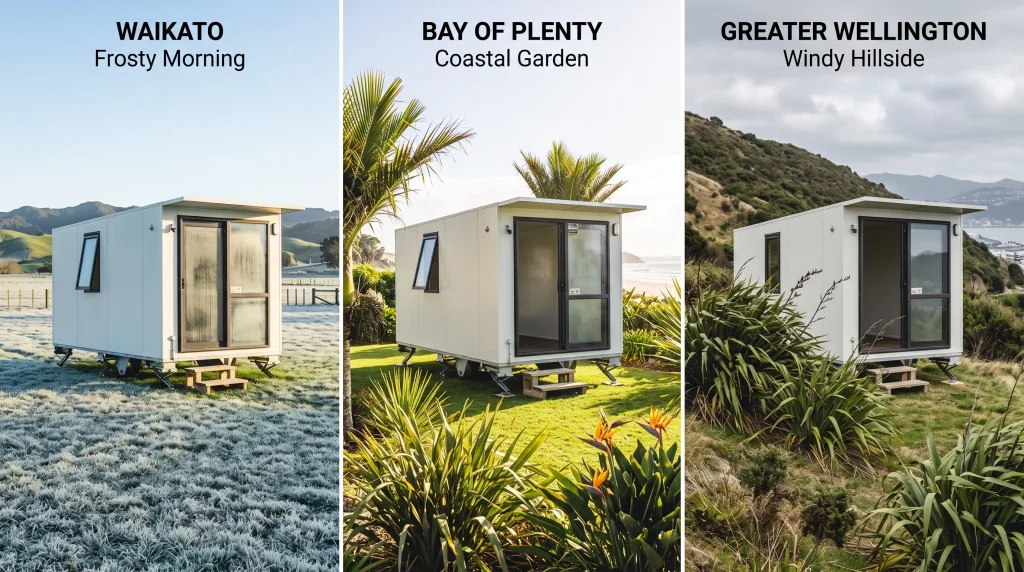
New Zealand weather changes from place to place, so a few checks are worth tailoring to where you live.
Hamilton and Waikato
Frosty mornings are the test here. On your first cold morning, check how the floor feels underfoot and whether the windows have fogged. Damp air near rivers and low ground can also make condensation worse. See our Waikato and Hamilton cabins page for local details, or read about cabin rentals for Hamilton and Waikato lifestyle spaces.
Bay of Plenty
Humidity is the thing to watch. After a warm, still night, look for condensation on the windows and sniff for mustiness when you open the door. Make sure the windows open properly so the air can move. Find out more on our Rotorua and Bay of Plenty cabins page.
Greater Wellington
Wind will show you a cabin’s weak spots fast. On a breezy day, listen for rattles and feel around the door and window edges for draughts. Ask how the cabin is set up on your site too. Our Greater Wellington cabins page has local details, and our guide to Wellington and Kāpiti wind zones is worth a read.
Key Benefits of Checking Quality First
A little checking up front pays off in a big way:
- You sleep and work better, because a warm, dry cabin makes a real difference.
- You stay safe, because you’ve seen the certificate and tested the alarms yourself.
- You avoid arguments, because your photos show what the cabin looked like on day one.
- You feel in control, because you know what you’re paying for and who to call.
Ready to See a Cabin You Can Trust?
You now know what proof to ask for, and that makes the next step easy. Browse our Standard, Large and Extra Large cabins, check that we cover your region, and then get in touch with the team. You can also call 0508 222 464 and ask us anything on this page. We’d be glad to send you the details.
Not ready yet? That’s fine. Subscribe to our newsletter for new tips as we publish them, or look through our photo gallery to see real cabins in use.
Trust What You Can Test
A quality portable cabin rental shouldn’t rely on a lucky guess. It should stand up to your questions, your torch and your first week of living in it. Ask for proof, test what you can, and pay attention to how the provider treats you along the way. If you’d like a hand, the team at Room2rent Mobile Cabins is only a phone call away.
Frequently Asked Questions
Ask for proof, not promises. Request the electrical safety certificate, the insulation details in writing, and recent photos of the exact cabin you’ll get. Then walk through it on handover day, checking the floor, walls, windows, power points, smoke detector and RCD. A good provider like Room2rent Mobile Cabins will welcome these checks, because they show you exactly what you’re paying for.
Do a ten-minute walk-through while the delivery team is still there. Walk the floor, look for stains on the walls and ceiling, open and lock the door and windows, and plug something into every power point. Press the test buttons on the RCD and smoke detector. Take dated photos, and report any problem before the team leaves, so it’s on record from the very first day and easy to sort out.
An RCD, or residual current device, is a safety switch that cuts the power in a fraction of a second if something goes wrong. It helps protect you from electric shock. Room2rent cabins come with an RCD switchboard and a certified electrical safety certificate. Press the test button on your first day to make sure it works, and reset it as the label explains. If it fails, tell your provider.
Ask which parts are insulated, such as the roof, walls and floor, and ask for the R-value in writing. Then test it yourself. Note the temperature morning and evening for a week, and watch for cold floors or heavy condensation on the windows. A well-insulated cabin holds a steady temperature. Room2rent cabins come with full thermal insulation, so ask for the details and compare them with how it feels.
Use your nose and your eyes. A musty smell when you open the door after a day shut up is the first warning sign. Then look for brown or grey stains on the ceiling and walls, peeling paint, and water gathering around the window frames. Damp is far easier to stop early, so tell your provider quickly rather than waiting to see if it clears up on its own. Good airflow and insulation help.
Yes. Take clear, dated photos of every wall, the ceiling, the floor, the door, the windows, the switchboard and the outside of the cabin, including any marks or scuffs. Send them to your provider on the same day and keep a copy for yourself. It takes about ten minutes, and it gives you both a clear, fair record of the cabin’s condition at the start of the rental. It’s quick, free and very useful.
With Room2rent, you normally give about three weeks’ notice when you’re ready to return the cabin, and collection is included in the price you paid at delivery. Leave the cabin clean and tidy, and compare it with your handover photos. The minimum rental is six months, depending on availability and region, but some renters keep the same cabin for years, so plan your notice early and keep a note of the date.
Room2rent says its weekly cost never increases, so the price you agree at delivery stays the same for the whole rental. Because terms can change, ask for this in writing before you sign, and check how the deposit and first week’s rent work. A fair provider is happy to put these details on paper, so you know exactly what you’re committing to for the whole time you rent. Keep a signed copy safe.
It can be, if the basics are in place. Look for an RCD switchboard, a certified electrical safety certificate, a working smoke detector and an outdoor security light. Room2rent cabins include all four. Test the smoke detector and RCD when you move in, keep heaters clear of bedding, and don’t overload the power points. If anything feels wrong, such as a burning smell, unplug things and call your provider.
Ask before you sign, and get a name and a phone number. Room2rent works through local franchise teams, and its team says you can call them if something goes wrong, so you’re dealing with a real person. Notice how quickly they reply to your first enquiry. That’s a good sign of how fast they’ll help later, when you need a repair, a quick fix or just some friendly advice. Good service matters.