What Kiwis Use Portable Cabins for (That Most People Don’t Expect)
The Trouble With Seeing Clients at Home
Portable cabin use ideas don’t have to stop at home offices and spare beds. Some of the smartest ones are rooms where you see people: therapy rooms, massage and bodywork rooms, tutoring spaces, lash and nail rooms, and private video-call rooms.
This guide is about those rooms. It shows what each one needs inside, how a client’s visit should feel from car to chair, and which rules to check before you book.
Let’s be straight about the problem. Seeing clients at home is awkward. A rented consulting room costs money and often comes with a lease. A cabin can give you a separate, calm room. But it isn’t a shortcut around the rules. Councils set limits on home businesses, some professions have their own requirements, and Room2rent rents its cabins for six months or more.
Yes, you can use a portable cabin as a therapy room, bodywork room, tutoring space, beauty room or private call room in New Zealand. Many small, single-storey cabins can go up without a building consent if they meet MBIE’s conditions. But your council’s district plan still decides whether clients can visit. Some jobs, like hairdressing, have extra premises rules. Room2rent cabins are insulated, come with a certified electrical set-up, and rent from six months. Check the rules first, then ask for a quote.
Key Takeaways
- Portable cabins work as therapy rooms, bodywork rooms, tutoring spaces, beauty rooms and private call rooms.
- Your council’s home-occupation rules decide whether clients can visit.
- Plan the whole client visit: parking, path, step, toilet access and privacy.
- Hairdressing needs registered premises with running water, so a no-plumbing cabin is a poor fit.
- Room2rent cabins rent for six months or more. Phone your council first and keep the answer in writing.
Looking for Other Cabin Ideas?
For home offices, guest rooms and crew housing, read the guide to portable cabin uses. For hobby rooms, sound rooms, games rooms and garden studios, try the guide to creative portable cabin uses. This guide covers rooms where clients come to you.
Can You Run a Therapy Room or Small Business From a Portable Cabin in NZ?
Yes. Portable cabins are used as therapy rooms, tutoring spaces, studios and home-based beauty or start-up offices, provided the site meets your council’s home-occupation rules and any professional requirements. Room2rent cabins are insulated and powered for regular client use, on rental terms of six months or more.
Let’s unpack the word “provided”. A home occupation is a small business run from a home. Councils allow it in most residential areas, but they set limits. Those limits often cover staff numbers, floor area, opening hours, signs and parking. Wellington City Council explains that a small home business doesn’t need resource consent if it meets the rules for your zone. It also describes a home business as one run by at least one person who lives on the site. Palmerston North City Council lists similar conditions and says you can apply for a certificate of compliance once you think you meet them.
Five Portable Cabin Use Ideas for Seeing Clients
Therapy and counselling rooms
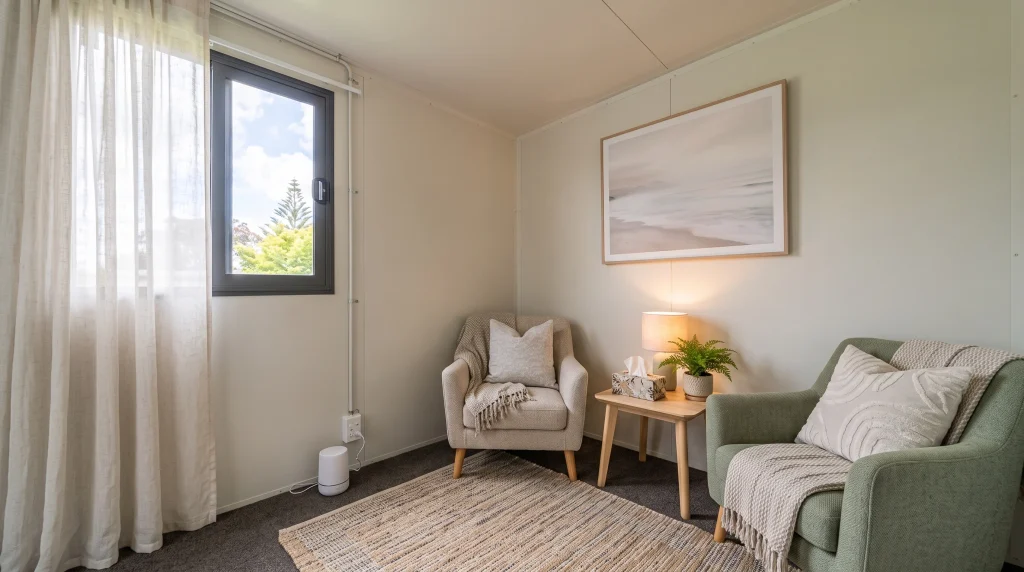
For therapy, speech privacy is everything. Clients need to feel safe saying hard things, and neighbours shouldn’t hear a word. A cabin sits apart from the house, so there’s no family noise and no shared hallway. A Large cabin usually has room for two chairs and a small table without feeling squashed. Add a solid door, door seals, rugs and a white-noise machine outside the door. Choose a quiet heater too, because a loud fan makes people raise their voices. Room2rent’s guides to heating a cabin in winter and using a cabin as a quiet room are worth a read.
Massage, bodywork and wellbeing rooms
A treatment table is about 1.8 to 2 m long, and you need space to walk around it. That makes a Large or Extra Large cabin the safer pick. Clients lie still, so warmth matters. Insulation helps, and a quiet, safe heater does the rest. Laundry is the hidden job, because the cabin has no plumbing. Plan where towels and linen get washed. Some bodywork roles, like physiotherapy, are regulated health professions with their own boards, so check your own requirements first.
Tutoring, language and music lessons
A backyard cabin draws a clear line between home life and lesson time. It suits one-to-one literacy help, NCEA tutoring, language lessons and exam prep. Think early about parking and drop-off. Councils often limit how many visitors arrive at once, so spread your lesson times out. Music lessons make noise, so check your council’s noise limits and have a chat with your neighbours.
Lash, brow, nail and beauty rooms
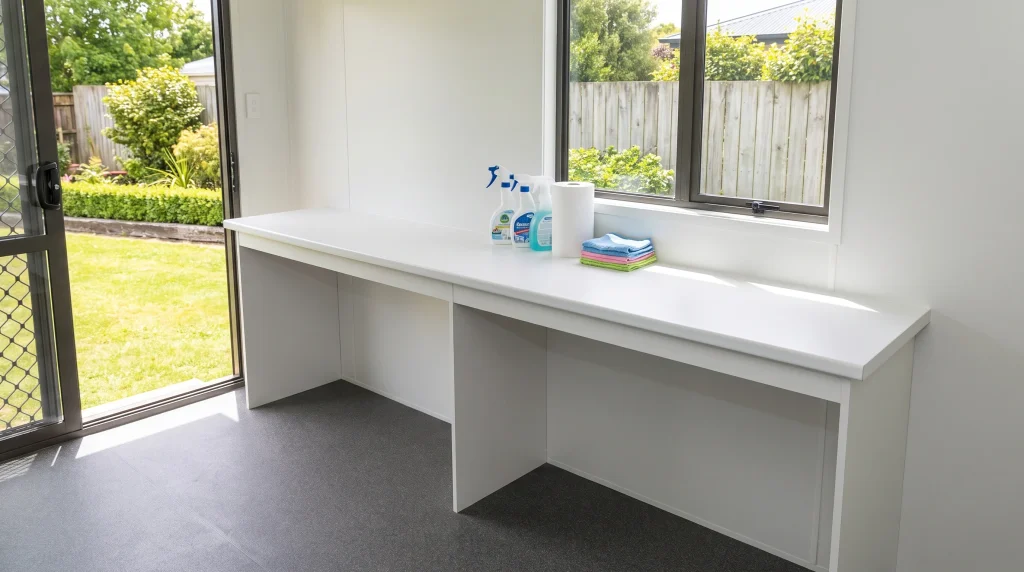
Beauty clients want calm, clean and private. A cabin gives them a separate door instead of the family hallway. Plan for good ventilation, because nail and lash products have fumes, and read Room2rent’s tips on preventing damp. Add a wipe-clean bench and floor, bright task lighting and a handwashing spot close by. The cabin runs from one standard 3-pin socket, so lamps, a steriliser and a heater all share it. Hairdressing is different, and the rules section below explains why.
Private video-call rooms
Counsellors, coaches, tutors and interpreters often work online, and they still need a quiet room where nobody overhears. A cabin gives you a door that closes. Sort your internet set-up before you move in, because a weak signal ruins a session faster than a noisy street.
From Car to Chair: Planning the Client’s Visit
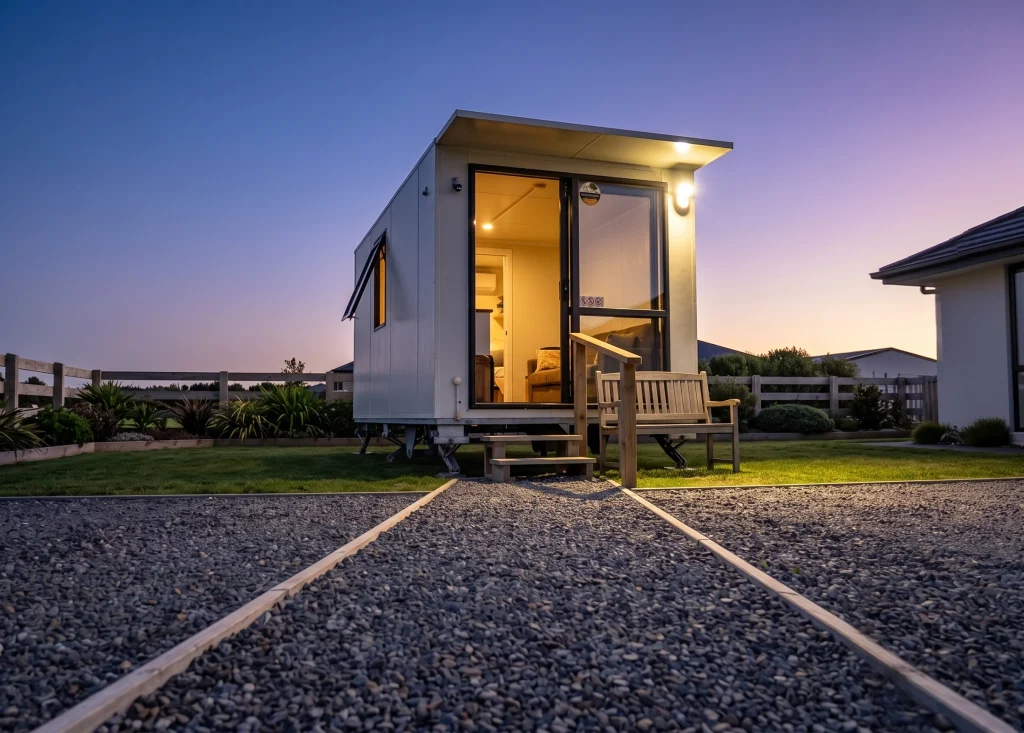
A good room isn’t enough. Walk the visit as a client would. Where do they park? Is the path clear and lit on a winter evening? Room2rent cabins come with an outdoor security light and an outside step, which helps.
Then think about the toilet. A Room2rent cabin is supplied without plumbing, so clients need another option, such as the bathroom in your house. Plan a private route. Finally, think about access. The cabin arrives with an outside step, so ask Room2rent whether level access or a ramp is possible if clients use wheelchairs or walkers. Also ask your council whether client visits change what the building needs.
Your Fit-Out Checklist by Use
Use this table to plan the inside of your cabin. The sizes are suggestions only. Room2rent’s guide to choosing the right cabin size can help you match one to your equipment and client numbers.
| Use | Cabin size to consider | Must-haves inside | Ask before you book |
| Therapy or counselling | Large or Extra Large | Solid door and seals, rugs and soft furnishings, white-noise machine, quiet heater, lockable storage for client notes | Client numbers and hours, professional body rules |
| Massage or bodywork | Large or Extra Large | Treatment table with walking space, quiet heater, storage for clean linen | Where laundry is done, professional body rules |
| Tutoring or music lessons | Large | Table, chairs, good lighting, Wi-Fi | Visitor numbers, parking, noise limits |
| Lash, nail or beauty | Standard or Large | Ventilation, wipe-clean floor and bench, task lighting, a handwashing spot nearby | Power for lamps and heaters on one 3-pin supply, council health rules |
| Video-call room | Standard | Desk, comfy chair, Wi-Fi, soft furnishings to cut echo | Internet set-up, noise from the yard |
| Hairdressing | Not usually a fit | Hot and cold running water and wash-hand basins are required | Registered premises |
What the Cabin Already Has, and What You Add
Room2rent’s cabins arrive ready to use. This table shows what that means for a room where you see people.
| Already in the cabin | Why it matters for clients | What you add |
| Full thermal insulation. [Insert wall, roof and floor R-values from Room2rent’s build spec] | A steadier temperature and some outside noise softened | Door seals, rugs, soft furnishings |
| Two double power outlets, fed by a 20 m cord into a regular 3-pin socket | Enough for lamps, a laptop and a small heater | A quiet heater, and a check with the team before you run several big appliances at once |
| RCD switchboard and a certified electrical safety certificate | Documented electrical safety | Keep a copy of the certificate handy |
| LED lights inside and out, a smoke detector, an outdoor security light and an outside step | A safer arrival on dark evenings | Path lighting and a clear route from parking |
For more, see the cabins page, cabin insulation and power and water set-up guides.
Six months is the minimum rental period, depending on availability and region. That suits a practice you’re building, but it isn’t a one-month trial. Before you sign, read the booking guide and the pricing guide.
Rules to Check Before You Book (2026 Update)
Three questions get mixed up here: how the cabin is built, where it sits and how you use it, and who you are as a professional. Each has a different person to ask.
Building consent. Many small, single-storey cabins with no plumbing or cooking are exempt from building consent, but the conditions depend on size and who designed the cabin. See MBIE’s guidance for buildings up to 10 m² and 10 to 30 m². Boundary rules changed in late 2025, so check the current guidance. Ask Room2rent which route your cabin uses, in writing, and read its council consent guide for the detail.
Professional and premises rules. Hairdressers must register their premises with the council, and the Health (Hairdressers) Regulations 1980 require hot and cold running water and wash-hand basins. Psychologists and psychotherapists must be registered with the NZ Psychologists Board or the Psychotherapists Board. Counsellors aren’t registered the same way, but many join the NZ Association of Counsellors. For beauty, lash and nail work, ask your council’s environmental health team.
Rules change, and each council words them differently. When you call, ask three things. How many clients can visit in a day, and at what hours? Can I put up a sign, and how big? Where should clients park? Then ask if you must live on the property. Write down who you spoke to, and the date. If the answer is “yes, but”, ask what the “but” is.
Where Room2rent Delivers, and Which Council to Call
Room2rent delivers across the North Island and the top of the South Island. Home-business rules are set locally, so phone the council for the address where the cabin will sit. Each region links to Room2rent’s local page.
| Room2rent region | Councils to ask |
| Auckland | Auckland |
| Hamilton and Waikato | Hamilton City, Waikato District |
| Rotorua and Bay of Plenty | Rotorua Lakes, Tauranga City, Western Bay of Plenty District |
| Hawke’s Bay | Napier City, Hastings District, Central Hawke’s Bay District |
| Taranaki and New Plymouth | New Plymouth District, Stratford District, South Taranaki District |
| Taupō and Central Plateau | Taupō District, Ruapehu District |
| Rangitīkei and Whanganui | Rangitīkei District, Whanganui District |
| Manawatū and Palmerston North | Palmerston North City, Manawatū District |
| Horowhenua | Horowhenua District |
| Wairarapa, Masterton and Carterton | Masterton District, Carterton District, South Wairarapa District |
| Kāpiti Coast | Kāpiti Coast District |
| Greater Wellington | Wellington City, Hutt City, Upper Hutt City |
| Nelson, Tasman, Blenheim, Marlborough and Picton | Nelson City, Tasman District, Marlborough District |
Each name ends in “Council” and is an example, so check yours. If your town isn’t listed, search your local council’s district plan for “home occupation”.
Key Benefits of a Cabin as Your Practice Room
A separate front door. Clients arrive at your cabin, not your kitchen.
Better confidentiality. A closing door, a quiet position on the section and soft furnishings all help conversations stay private. See how to add privacy without renovating.
Home life stays home. When you step outside, work begins. When you step back in, it ends. Room2rent’s guide to work-life separation with a cabin goes deeper.
No build. You pay rent, not building costs, and you know your minimum term up front. If you’re weighing it up, read renting vs buying a portable cabin.
Ready to Try It? Get Your Cabin Quote
Start with three small steps. Check your council’s home-occupation rules. Pick a cabin size that fits your work. Then ask Room2rent for a quote and a site check.
Check the regions page to confirm delivery near you, and browse the photo gallery to see real set-ups. The FAQs page answers common questions. Not sure where to start? Talk to the Room2rent team or call 0508 222 464.
Your Best Room Might Be in the Backyard
The right cabin gives clients a calm, separate place to visit, without an extension or a commercial lease. Plan the visit and check the rules first, and a small cabin can hold a practice, a lesson space or a beauty room. If you’re ready to see what fits your section, contact Room2rent and ask for a quote.
Frequently Asked Questions
Yes, if the site meets your council’s home-occupation rules and any professional requirements. Plan for sound privacy: a solid door, door seals, soft furnishings and a white-noise machine outside the door all help. Ask your council about client numbers, opening hours and parking before you book, and keep its answer in writing. Your professional body may also have standards for the room where you see clients.
Psychologists and psychotherapists must be registered with their boards to use those titles, wherever they see clients. Counselling isn’t registered the same way, but many counsellors join the NZ Association of Counsellors. Registration covers you, not the room, so you still need to check your council’s home-occupation rules for the cabin. Confirm the current rules with your own professional body.
Start with a solid door and door seals, then add rugs, curtains and soft furnishings to soak up echo. Put a white-noise machine outside the door so voices don’t carry. Place the cabin away from the boundary and your neighbours’ windows, and face the door away from them if you can. Choose a quiet heater too, because a noisy fan makes people raise their voices. Seal any gaps around the door too.
Room2rent cabins are supplied without a toilet or plumbing, so clients need another option. One choice is the bathroom in your house, with a private route and a heads-up to your household. This matters most for longer sessions and for children. Keep the route clean and private. Ask your council whether any premises rules apply to your kind of work, and confirm the plumbing point with Room2rent before you book.
There’s no single national number. Your council’s district plan sets the limits, and they often cover client numbers, visiting hours, staff, signs, parking and noise. Some councils also expect the operator to live on the property. Search your district plan for “home occupation”, then phone the planning team with three details: how many clients a day, what hours, and where they park. Ask them to reply in writing.
Ask the council for the address where the cabin will sit, because district plan rules are set locally. Room2rent serves regions including Auckland, Rotorua and Bay of Plenty, Hawke’s Bay, Taranaki, Taupō, Whanganui, Manawatū, Horowhenua, Wairarapa, Kāpiti Coast, and Nelson, Marlborough and Picton. Ask that council’s planning team about home occupations, including signs, and get its answer in writing.
Often yes, if your council’s home-occupation rules are met. Plan for visitor numbers, drop-off and parking, and stagger lesson times so cars don’t pile up. Music lessons make noise, so check your council’s noise limits and talk to your neighbours. A Large cabin fits a table and chairs, or an instrument and a stool. If you teach children, follow any guidance from your professional body or tutoring agency.
Lash, brow and nail work may suit a cabin if you plan ventilation, a wipe-clean bench and floor, and a handwashing spot nearby. Local health rules vary, so ask your council. Hairdressing is different. Hairdressers must register their premises, and the rules need hot and cold running water and wash-hand basins. Room2rent cabins are supplied without plumbing, so hairdressing is a poor fit.
Room2rent cabins arrive with an outside step, so a standard set-up isn’t step-free. If clients use wheelchairs, walkers or crutches, ask Room2rent whether level access or a ramp is possible before you book, and plan a smooth path from parking to the door. Ask your council whether client visits trigger access requirements for the building. Get the answer in writing before you spend money on fit-out.
Six months is Room2rent’s minimum, depending on availability and region, so it isn’t a one-month trial. Before you sign, add up rent, delivery, the deposit and your fit-out, and check you can cover six months even if clients are slow to arrive. Talk to the team early about extending or ending the rental. Room2rent’s pricing guide is a good place to start. Ask for current figures in writing.