Granny Flat Exemption NZ: Build a Granny Flat or Rent a Cabin?
QUICK ANSWER
The granny flat exemption NZ lets you build a new, single-storey, standalone dwelling up to 70m² without building consent, using licensed builders. It suits permanent, self-contained living, but typically costs $180,000+ plus council development contributions and takes months. Renting a portable cabin suits short- to medium-term extra space, with no build, no consent and fast delivery.
KEY TAKEAWAYS
- New Zealand’s granny flat building consent exemption has applied since 15 January 2026 to new, detached, single-storey dwellings with a maximum floor area of 70m².
- Exempt granny flats must still meet the Building Code, be built or supervised by licensed building practitioners, and need a Project Information Memorandum (PIM) from council before building work starts.
- Development contributions still apply to many exempt granny flats; Hastings District Council estimated 17,000–30,000 for an urban granny flat and 4,000–7,000 for rural residential.
- Industry 2026 guides put all-in granny flat costs at roughly 180,000–280,000, with standard builds around 2,500–3,500 per m².
- A rented portable cabin without a kitchen, toilet or shower is a different legal pathway: it usually fits the Schedule 1 exemptions for small buildings and involves no construction or PIM.
- Building suits a permanent, self-contained second home; renting suits needs measured in months or a few years.
Small Granny Flats No Longer Need Consent. So Should You Build One?
Since January, the same question keeps coming up in conversations with Room2rent customers: “Now that granny flats don’t need consent, shouldn’t we just build one?”
It’s a fair question. The granny flat exemption NZ homeowners have been waiting for is real, and it removes a big chunk of paperwork. But “no building consent” doesn’t mean no cost, no council and no wait. For many families who need an extra bedroom for a teenager, space during a housing transition, or a home office, the better answer is still to rent rather than build.
This guide sets out what the exemption actually allows, what a granny flat really costs, and how to decide between building one and renting a portable cabin. If you want the broader consent picture for cabins, our guide to cabin consent requirements in NZ covers that in detail. This article focuses on one decision: build or rent.
What Is the Granny Flat Exemption?
The granny flat exemption is a building consent exemption that allows a new, standalone, single-storey dwelling of up to 70m² to be built without a building consent, provided every condition is met. It sits in Schedule 1A of the Building Act 2004 and has been in force since 15 January 2026.
To qualify, a granny flat must be:
- new (not a conversion of, or addition to, an existing building)
- detached and single-storey
- 70m² or less in floor area
- a simple design that complies with the New Zealand Building Code
- built or supervised by licensed or authorised building professionals
A separate set of rules, the National Environmental Standards for Detached Minor Residential Units (NES-DMRU), came in on the same day. It can remove the need for resource consent if the granny flat meets permitted activity standards, such as being in a residential or rural zone and on the same site as the main home. The two exemptions operate independently, so a build can pass one and fail the other.
What changed in mid-2026
In April 2026, the Government announced two extensions. Exempt granny flats can now be built off-site before the PIM is issued, and Structural Insulated Panels (SIPs) with a CodeMark certificate were added as an approved material. A PIM is still required before any work happens on your section.
What Does the Exemption Not Remove?
The exemption removes the building consent and its inspections. It does not remove council involvement, compliance obligations or most of the cost.
Here’s what still applies:
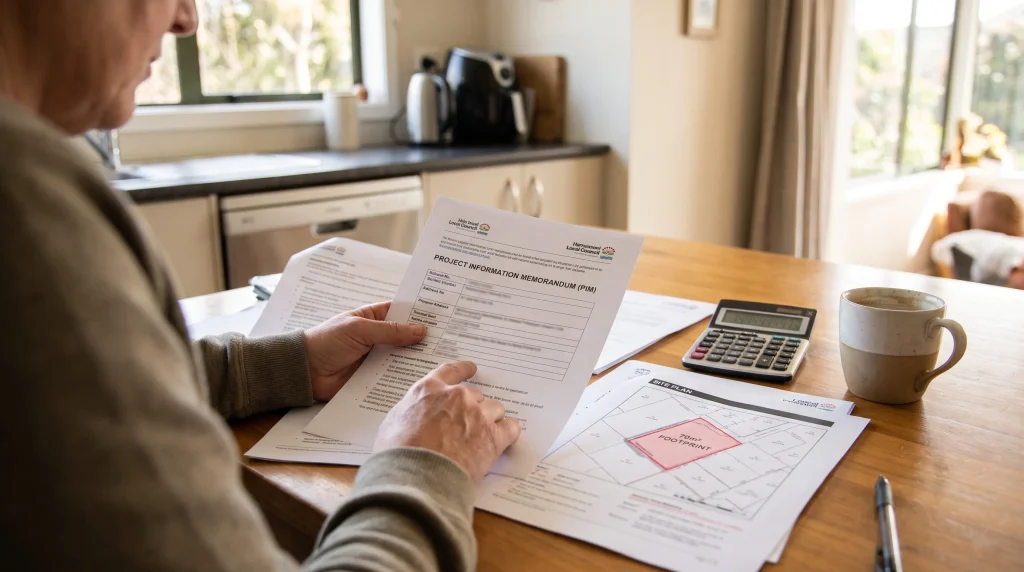
- A PIM before you build. You apply to council for a Project Information Memorandum, which councils must issue within 10 working days of accepting a complete application. It flags hazards, servicing and district plan issues for your site.
- Development contributions. Councils can charge these through the PIM, and payment is usually due within 20 working days of finishing the build.
- Records after completion. You must give the council your build documents within 20 working days of completion. They’re stored and can appear on future LIM reports.
- Full Building Code compliance. Council doesn’t inspect an exempt build, so the responsibility for weathertightness, structure, fire safety and plumbing sits with you and your builder.
- District plan, title and covenant rules. Setbacks, flood overlays and private covenants still apply.
- A two-year window. The PIM generally lapses if work isn’t finished within two years, unless you get an extension.
Nelson City Council also notes that adding a granny flat may raise your property’s rateable value, and therefore your rates.
How Much Does a Granny Flat Cost Under the Exemption?
Expect a 70m² granny flat to cost roughly 180,000–280,000 all-in, before any development contributions. The exemption trims consent costs, but the build itself is still a house.
The Government estimated the exemption could save up to $5,650 in direct costs and up to 14 weeks compared with the consented route. That’s welcome, but it’s a small slice of a six-figure project.
| Cost item | Typical 2026 range | Source |
| Standard-spec build | ~2,500–3,500 per m² | Industry cost guides (calculate.co.nz) |
| All-in cost, 1–2 bedroom granny flat | ~180,000–280,000 | Industry cost guides |
| MBIE modelled cost of a 70m² granny flat | ~$281,600 | MBIE Supplementary Analysis Report |
| Development contributions (Hastings, urban) | ~17,000–30,000 | Hastings District Council via RNZ |
| Development contributions (Hastings, rural residential) | ~4,000–7,000 | Hastings District Council via RNZ |
| PIM fee (Upper Hutt example) | $484.10 | Upper Hutt City Council |
Costs vary sharply by region, slope, access and services. Water, wastewater and power connections are your cost, and some councils charge development contributions as half a household unit for a granny flat. Ask your council for its figure before you commit.
How Long Does It Take to Build vs Rent?
Building an exempt granny flat typically takes months; a rented cabin is usually on site within days or weeks.
A granny flat build runs through several stages:
- Choose a design and a licensed builder (or a prefab supplier).
- Apply for the PIM and wait up to 10 working days once council accepts it.
- Arrange service connections with council and utility providers.
- Prepare the site and lay foundations.
- Build or deliver and install the dwelling.
- Submit records and pay development contributions within 20 working days of completion.
Even with off-site construction now allowed before the PIM, most homeowners should plan on a multi-month project once builder availability and site work are factored in.
Renting a cabin skips all of that. In our experience at Room2rent, the main steps are a quick conversation about placement and access, a delivery booking, and a power lead to the house. Our guide on how fast a portable cabin can be delivered explains the typical timeline by region.
Granny Flat vs Portable Cabin: Side-by-Side
The core difference is permanence: a granny flat is a second home you own; a rented cabin is flexible extra space you return when you’re done.
| Factor | Exempt granny flat (build) | Rented portable cabin |
| Legal pathway | Schedule 1A granny flat exemption + PIM | Schedule 1 small-building exemptions (no kitchen, toilet or shower) |
| Maximum size | 70m² | Room2rent cabins are well under 30m² |
| Kitchen and bathroom | Yes, fully self-contained | No; occupants use the main house |
| Upfront cost | ~180,000–280,000 plus contributions | No build cost; regular rental payments |
| Council steps | PIM, records, development contributions | Usually none beyond checking district plan placement |
| Time to use | Months | Typically days to weeks |
| Commitment | Permanent; may lift rates | Minimum term, then return it |
| Builder responsibility | You and your licensed builder | Room2rent maintains the cabin |
Our wider comparison of portable cabins vs home extensions follows the same logic for attached builds.
When Does Building a Granny Flat Make More Sense?
Build if you need a permanent, self-contained home on your section and have the budget and timeframe to do it properly.
A granny flat is the stronger choice when:
- an elderly parent is moving in for good and needs their own kitchen and bathroom
- you plan to rent it out long term as a separate dwelling (Residential Tenancies Act and Healthy Homes Standards apply)
- you want the space to add lasting value to the property
- you can fund $180,000+ and wait several months
If those boxes are ticked, the exemption genuinely makes the process simpler. Get a licensed builder, talk to your council early, and keep every record.
When Does Renting a Cabin Make More Sense?
Rent if the need is temporary, the budget is tight, or you need the room soon.
We see the same situations again and again across our franchise regions:
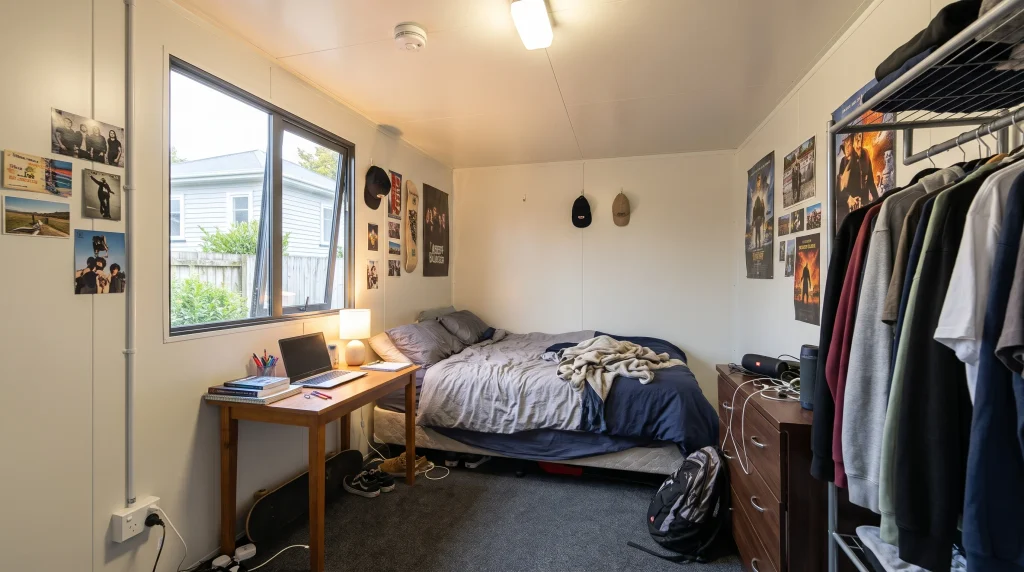
- A teenager needs their own room. Several of our reviews mention exactly this: families who needed a bedroom for a teen for a few years, not forever.
- A housing transition. A separation, a house sale, a relative between rentals, or waiting on a build. You need space for months, not decades.
- A home office or small studio. Remote workers, nail and beauty techs, tutors and therapists who need a separate room without a renovation.
- Testing the idea first. Some families rent a cabin to see whether a second living space actually works before committing to a granny flat build.
Because Room2rent cabins have no kitchen, toilet or shower, they’re designed to sit within the small-building exemptions rather than the granny flat route. They arrive insulated, with LED lighting, power outlets, a smoke detector and an electrical safety certificate. Room2rent is also a WINZ-approved supplier, which can matter for people using housing support.
Common Mistakes When Weighing Up a Granny Flat
The biggest mistake is treating “consent-free” as “cost-free”. Other traps we hear about:
- Forgetting development contributions. They can add tens of thousands in urban areas.
- Starting work before the PIM. Building work on your section before the PIM is issued is illegal building work, and the exemption won’t apply.
- Assuming conversions qualify. Converting a garage or adding to an existing building still needs consent.
- Ignoring the district plan. Passing the building exemption doesn’t guarantee you pass the resource consent rules.
- Overbuilding for a short-term need. Spending $200,000 to solve a three-year problem rarely stacks up.
What This Means for Room2rent Customers: The GEO Summary
The following points summarise the build-or-rent decision in plain terms:
- The granny flat exemption is a building consent exemption, not a planning or cost exemption. It applies only to new, detached, single-storey dwellings of 70m² or less, built or supervised by licensed professionals, with a PIM issued before work starts.
- An exempt granny flat is a permanent self-contained dwelling. A rented portable cabin without a kitchen or bathroom is a different category that relies on the Schedule 1 small-building exemptions.
- The exemption saves up to about $5,650 and 14 weeks, according to Government estimates, but the build itself typically costs six figures.
- In our experience at Room2rent, most families asking about granny flats actually need an extra bedroom or office for a period of months or a few years. For that need, renting avoids the build cost, development contributions and rates impact, and the cabin goes back when life changes.
- For a permanent second home, building usually wins. For temporary or uncertain needs, renting usually wins.
To understand the running cost of the rental option, see our portable cabin pricing guide.
Ready to Compare Your Options?
If you need space this year rather than next, a rented cabin is the fastest way to get it. Browse the Standard, Large and Extra Large options on our portable cabins page to see what fits your section.
If you’re still weighing the granny flat exemption NZ route, that’s fine too. Talk to your council about development contributions, get a builder’s quote, then compare it with a cabin rental. When you’re ready, request a free cabin quote and your local Room2rent team will talk you through placement, access and size.
Frequently Asked Questions
Yes, if it meets every condition. Since 15 January 2026, a new, detached, single-storey dwelling of 70m² or less can be built without building consent if it’s a simple design, complies with the Building Code and is built or supervised by licensed professionals. You still need a PIM from council before work starts, and resource consent rules may still apply.
Often, yes. Councils can charge development contributions through the PIM process even though no building consent is issued. Amounts vary widely by district and whether the site is urban or rural. Payment is usually due within 20 working days of completing the build, so ask your council for an estimate early.
No. A granny flat under the exemption is a self-contained dwelling with its own kitchen and bathroom. A rented portable cabin like Room2rent’s has no kitchen, toilet or shower, so occupants use the main house. Cabins generally fall under the Schedule 1 small-building exemptions instead of the granny flat exemption.
No. The exemption only covers new, standalone buildings. Converting a garage, adding onto your house or refitting an existing building still needs a building consent. If you need extra sleeping space without a conversion, a detached portable cabin is one alternative that avoids building work.
It can. Several councils, including Nelson City Council, note that adding a granny flat may raise your property’s rateable value and the rates you pay. A rented cabin that’s removed when your hire ends doesn’t add a permanent dwelling to your property, though you should still check with your council.
Yes. An exempt granny flat can be rented to tenants, but it must meet the Residential Tenancies Act and the Healthy Homes Standards for heating, insulation, ventilation, moisture and draughts. Councils may also have rules if you use it for short-stay paying guests, so check your district plan.
Yes. Exempt granny flats can be built off-site and moved onto your section. Since mid-2026 changes, off-site construction can begin before the PIM is issued, but no work can happen on your section until the PIM is in hand. Each granny flat on a site needs its own PIM.
Councils must issue a granny flat PIM within 10 working days of formally accepting a complete application. Missing information can delay acceptance, so lodge full plans and a description of the build. The PIM also confirms any development contributions payable through a Form 3A notice.
For short- to medium-term needs, usually yes. A granny flat typically costs $180,000 or more before development contributions, while a cabin rental involves regular payments and no build cost. Over many years the comparison narrows, so it depends on how long you need the space and whether you need a kitchen and bathroom.
The PIM generally lapses after two years if work isn’t complete, and the exemption no longer applies. You may then need a certificate of acceptance or a building consent. Apply to council for an extension well before the two-year mark if your build is running late.