Portable Cabins vs Home Extensions: How Long Until You Move In?
The Waiting Game Nobody Warns You About
You need more room, and you need it soon. Maybe a baby is on the way, a parent is moving in, or you’ve just started working from home and the dining table isn’t cutting it. So you start pricing an extension, and that’s when the real surprise hits. It isn’t only the cost. It’s the wait.
Between design, council consent and building, an extension can take many months before you can put a bed or a desk in the new space. A portable cabin works on a completely different clock. Once it’s booked and your site is checked, it’s usually delivered within days.
Building consent alone has a legal processing time of 20 working days, but real-world approvals often take 3 to 6 months. A standard extension then takes 4 to 7 months to build. Add those together and you could be waiting well over half a year. A Room2rent portable cabin is usually delivered within days of booking, and most small cabins don’t need building consent. If time matters, a cabin wins by months.
Key Takeaways
- Building consent has a 20-working-day legal limit, but often takes 3–6 months in practice.
- A standard extension then takes 4–7 months to build.
- A Room2rent cabin is usually delivered within days of booking.
- Small cabins usually don’t need building consent, but check placement with your council.
- Choose an extension if you need plumbing or permanent space and can wait.
- Room2rent delivers across 13 service regions.
What the Timeline Really Means for You
Portable cabins vs home extensions in NZ comes down to one simple question: how soon do you need the space? An extension is a building project, with designers, council officers and builders, and each step has its own queue. A portable cabin is a finished room that turns up on a trailer.
This guide walks you through both timelines, stage by stage. You’ll see how long consent really takes, how long building takes, what can cause delays, and how a cabin delivery works from first call to first night. If you’re weighing up the money side, our guide to the top 5 benefits of renting a portable cabin vs building an extension covers the costs in detail.
How Much Faster Is a Cabin Than a Home Extension?
A portable cabin is usually months faster. Room2rent cabins are often delivered within days of booking, while an extension typically needs 3 to 6 months for consent in practice and another 4 to 7 months to build.
The Extension Timeline, Stage by Stage
An extension has three big stages, and each one can stretch. Here’s what each involves and how long it tends to take.
Stage 1: Design and Drawings
Before anything else, you need plans. A designer or architect measures your house, sketches options and prepares drawings detailed enough for council. This stage can take several weeks, and longer if you change your mind or your designer is booked up. You’ll also need quotes from builders, which adds more time.
Stage 2: Building Consent
Any extension that adds floor area needs building consent, and this is where many projects stall. Under the Building Act, your council has 20 working days to process a complete application. That sounds quick, but the same government guidance explains the clock stops whenever council asks for more information.
That happens a lot. Concepts & Consents reports that more than 64% of applications are paused for information requests, and that real-world consent times often run to 3 to 6 months or longer. Every back-and-forth adds days or weeks to your wait.
Stage 3: Building Work
Once consent is granted, the build itself begins, and it isn’t quick either. Builders Near Me NZ puts a standard home extension at 4 to 7 months from the day construction starts. CheckMyBuilder gives a shorter typical range of 8 to 20 weeks for simpler projects. Weather, material delays and surprises inside old walls can all push that out.
The Cabin Timeline, Stage by Stage
A cabin skips the design, consent and build stages because the room already exists. Here’s how the process usually runs, based on Room2rent’s delivery timeframe guide.
Step 1: Call and Choose
You start with a quick chat about what you need. The team helps you pick a size, and our size comparison guide makes that choice easier. There are no plans to draw, and our step-by-step booking guide shows what to have ready before you call.
Step 2: Site Check
Next, the team checks your site, often using online maps or a free site visit. They look at driveway width, ground level and anything in the way. It’s also a good moment to call your council’s duty planner to confirm your chosen spot meets local placement rules. Our guide to the rental and delivery process explains what the team looks for.
Step 3: Delivery and Placement
On delivery day, the cabin is towed in, positioned and levelled on adjustable legs. It can sit on concrete, gravel or grass. Room2rent says delivery often happens just days after booking, with remote areas sometimes taking a little longer. Our delivery logistics guide explains what happens on the day.
Step 4: Plug In and Move In
Once it’s placed, you plug it into power and it’s ready to use. Cabins arrive insulated and secure, so you can move furniture in straight away. Our guide to power and water setup covers the details, and our tips on getting your cabin online help if you’ll work from it.
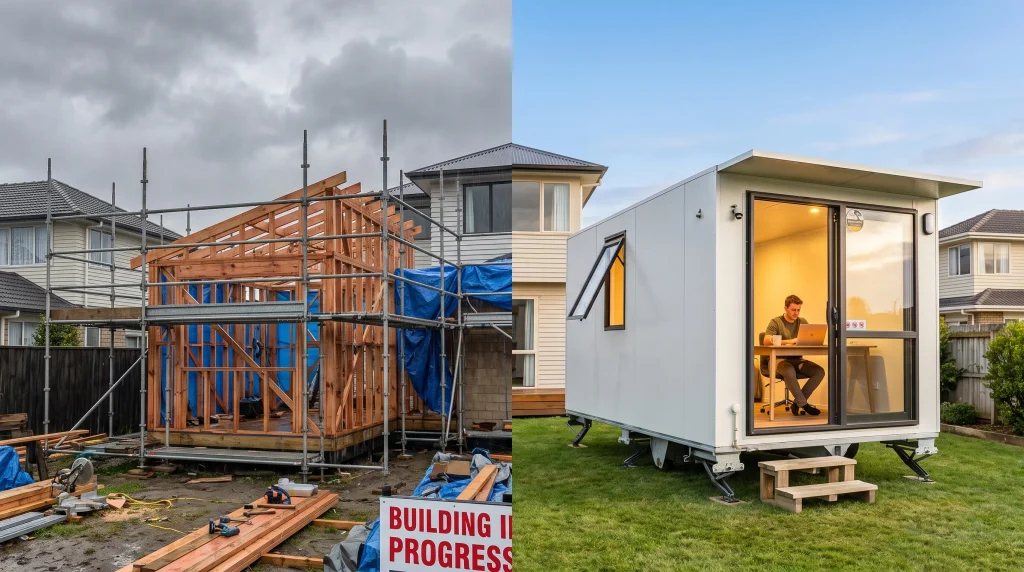
Side-by-Side Timeline: Weeks to Move In
Put the stages next to each other and the gap is huge. This table uses the sourced timeframes above.
| Stage | Home extension | Room2rent portable cabin |
| Planning | Design and drawings, usually several weeks | A short chat to choose a size |
| Approval | 20 working days by law, often 3–6 months in practice | Building consent usually not needed for small cabins |
| Construction | 4–7 months (8–20 weeks for simpler jobs) | None, the cabin is pre-built |
| Delivery and setup | Not applicable | Usually within days of booking |
| Rough total to move in | Often 6 months to a year or more | Usually days to a couple of weeks |
What Your Calendar Could Look Like
Here’s the same comparison as a simple story. In week one, if you choose an extension, you’re likely still meeting designers. If you choose a cabin, it may already be in your backyard. By month three, the extension may still be waiting on council. The cabin has been an office or a sleepout bedroom for months. By month six, building work on the extension may only just be under way, while the cabin has quietly done its job the whole time.
That’s the real difference. It isn’t just speed. It’s months of living with the space you need, rather than months of waiting for it.
Why Extensions Get Delayed
Delays are common, and they’re usually outside your control. Council information requests are the biggest one, as the consent stats above show. Builder availability is another, since good builders are often booked out ahead. Weather can stop work on roofs and foundations. And older homes can hide problems, like rotten framing or old wiring, that only appear once walls are opened up.
A cabin avoids almost all of these. There’s no council queue for a small, exempt cabin, no builder booking and no hidden surprises in your walls. Our council consent guide explains which cabins are usually exempt and what you should still check with your council.
Delivery Across Our Regions
Room2rent delivers across 13 regions, and lead times depend mostly on distance and site access. In the upper North Island, we cover Auckland West, Waikato and Hamilton, Rotorua and the Bay of Plenty and Taupō and the Central Plateau.
Further south, we deliver to Hawke’s Bay, Taranaki and New Plymouth, Whanganui and Rangitīkei, Manawatū and Palmerston North and Horowhenua.
Around the capital, we cover the Kāpiti Coast, Greater Wellington and the Wairarapa, Masterton and Carterton. Across Cook Strait, we deliver to Nelson, Tasman, Blenheim, Marlborough and Picton. Rural or hard-to-reach sites may take a little longer, so ask for a delivery date when you get your quote.
Key Benefits of Choosing the Faster Option
You Solve the Problem Now, Not Next Year
A cabin gives you the space while you still need it. Many space problems are short-term. A new baby, a parent recovering at home, or a stretch of remote work won’t wait for a council queue. Our guide to cabins for short-term life changes shows how families use them.
You Avoid Months of Disruption
No building site means normal life carries on. You won’t have builders in your house, dust on every surface or a roof covered in tarps. It’s also one of the easiest ways to add privacy without renovating.
You Keep Your Plans Flexible
A cabin doesn’t lock you in. Room2rent’s minimum rental term is usually six months, depending on availability and your area. After that, you can keep it, change size or return it. Our cabin rental FAQs cover rental terms in more detail. If you later decide to build, the cabin can bridge the gap while your extension goes through consent. You could even rent a cabin instead of moving house.
You Still Get a Warm, Proper Room
Fast doesn’t mean flimsy. Room2rent cabins are insulated and wired for power, so they’re comfortable all year. Learn more in our guides to cabin insulation, winter heating and what makes a quality rental cabin.
How to Speed Up an Extension If You Still Want One
If you decide to build, a few smart moves can trim weeks off your wait. The biggest one is lodging a complete consent application. Because the council clock stops every time it asks for more information, missing details are the most common reason approvals drag on. Ask your designer to check every drawing and report against your council’s checklist before lodging.
It also helps to talk to builders early. Good builders are often booked months ahead, so getting quotes while your plans are still being drawn can save a long gap between consent and the first day on site. Finally, think about what you’ll do in the meantime. Many families rent a cabin as temporary space while their extension goes through consent and construction, so they have the extra room straight away instead of squeezing in for most of a year.
When Waiting for an Extension Makes Sense
If you need the space permanently and can wait, an extension may be the right choice. A cabin is a separate, dry room. It doesn’t include a bathroom or kitchen. If you need plumbing, or you want to add lasting value to your home, an extension is worth the wait. Planning a bathroom or kitchen upgrade inside your home instead? Our guide to portable cabins vs renovations covers that choice.
Book Your Cabin Delivery
The quickest way to get extra space is to ask for a delivery date today. Browse the Room2rent cabin range, see real setups in our photo gallery, then request a quote for your address. Tell us when you need the space, and the Room2rent team will tell you how soon we can get a cabin to you.
Space This Week or Space Next Year
Portable cabins vs home extensions isn’t only a question of money. It’s a question of time. An extension can give you a permanent room, but you’ll likely wait many months for it, through design, consent and building.
A cabin gives you a warm, private room almost straight away, and you can decide about the long term later. If your space problem is happening now, the faster answer is often the smarter one. Get your free quote from Room2rent and find out how soon a cabin could be on your section.
Frequently Asked Questions
Renting a portable cabin in NZ costs about $85 to $220 a week. Renovations cost much more upfront. A 2026 bathroom renovation typically runs $8,000 to $70,000, and a kitchen $15,000 to $90,000. A small extension costs about $80,000 to $120,000. A cabin adds a separate room for a weekly fee, while renovations improve rooms you already have. Pick the one that solves the real problem in your home.
A small 15–25m² home extension in NZ costs about $80,000 to $120,000 in 2026, before design and consent fees. Renting a Room2rent portable cabin costs about $85 to $220 a week, with most households paying $110 to $170. At $170 a week, a cabin costs around $8,840 a year, so it would take roughly nine years of rent to match a small extension’s build cost. Delivery and bond are extra.
Several NZ companies rent portable cabins to homeowners. Room2rent specialises in insulated cabins for homes and delivers across 13 regions, from Auckland to Picton. When you compare providers, look at weekly rates, delivery fees, insulation, minimum rental terms and local reviews. Ask each company for a written quote that includes delivery, bond and any power work, so you can compare fairly.
In Auckland, a small portable cabin usually rents for about $90 to $120 a week, with larger insulated cabins costing more, up to around $220 a week. Delivery is priced separately and depends on your address and site access. Auckland sometimes has faster turnaround than remote regions. Ask for a quote that shows the weekly rate, delivery fee and bond, so you know the full cost upfront.
Yes, when your main problem is a lack of space. A renovation improves rooms you already have, but it rarely adds a bedroom or office. A cabin adds a separate, insulated room within days, without builders or dust. It’s not a swap for plumbing work, though. If you need a new bathroom or kitchen, a renovation is still the right choice, and a cabin can be a handy bonus room.
According to 2026 figures from CheckMyBuilder, a bathroom renovation in NZ typically costs about $22,000, ranging from $8,000 for a simple refresh to $70,000 for a premium redesign. A kitchen renovation typically costs about $35,000, ranging from $15,000 to $90,000. Your final cost depends on the layout changes, materials, your region and whether plumbing or walls need to move.
Start with Google reviews on each supplier’s Business Profile, which show recent feedback from real customers. Local Facebook community groups are also good places to ask for honest opinions. Ask the supplier for references from customers in your area, and look through their photo gallery to see real cabins on real sections, not only marketing images. Compare a few before deciding.
A detached sleepout up to 10m² with no plumbing usually doesn’t need building consent in NZ. Larger ones up to 30m² can also be exempt if certain design conditions are met. A sleepout must rely on your main house for the bathroom and kitchen. Your council’s district plan may still set rules on boundary distances and site coverage, so check your placement before delivery.
A Room2rent portable cabin is often delivered within days of booking, depending on your location and site access. Placement usually takes a few hours on the day. Building projects take far longer. Consent alone has a 20-working-day legal timeframe but often takes 3 to 6 months, and a standard extension then takes 4 to 7 months to build. If you need space fast, a cabin wins easily.
The Building Act exemptions are national, so they apply in Christchurch too. A small detached cabin up to 10m² with no plumbing usually doesn’t need building consent, and some cabins up to 30m² can also be exempt. Christchurch City Council’s district plan may still have placement rules. Room2rent doesn’t currently deliver to Canterbury, so check with your council and a local supplier.