Do You Need Council Consent for Cabin Rentals? NZ Legal Guide
Before You Book: The Question That Stops Most Cabin Plans
You’ve found the right spot in the backyard. You know which size you want. Then one question stops you cold: am I actually allowed to put this here?
That question is what cabin rental consent requirements in NZ are all about. It’s the question we hear most at Room2rent Mobile Cabins. “Council consent” can mean two different approvals, the rules changed twice in the past year, and every council has its own district plan. This guide explains what applies to a rented cabin, what doesn’t, and exactly what to ask your council, in plain English.
Most Room2rent cabins don’t need a building consent. They’re small and single-storey, and they have no kitchen, toilet or shower. Schedule 1 of the Building Act 2004 exempts buildings like this, as long as a few conditions are met. You might still need a resource consent if the cabin breaks your district plan’s rules on boundaries or site coverage. Renting the cabin out to someone else can add further rules. Always check with your local council before your cabin arrives.
Last checked 28 September 2026 against three sources: MBIE’s guidance on building work that doesn’t need a consent, MBIE’s granny flat exemption guidance, and Auckland Council’s granny flat exemption page. Consent rules are council-specific and can change. Treat this guide as a starting point, not legal advice.
Key Takeaways
- “Council consent” means two checks: building consent (how it’s built) and resource consent (where it goes).
- Room2rent’s Standard cabin sits under 10m². The Large and Extra Large cabins sit in the 10–30m² band.
- Adding a kitchen, toilet or shower takes a cabin out of the exemption.
- Wheels don’t make a cabin exempt. The Schedule 1 conditions do.
- District plan rules on setbacks and site coverage still apply to exempt cabins.
- Renting to tenants or paying guests can bring in extra rules.
- Always confirm with your local council before delivery.
What “Council Consent” Really Means for a Cabin
“Council consent” usually means two separate checks: building consent and resource consent. Your cabin could need one, both or neither.
Building consent: how the cabin is built
Building consent is your council’s check that a structure meets the New Zealand Building Code. It covers strength, weathertightness and fire safety, and comes from the Building Act 2004.
Resource consent: where the cabin goes
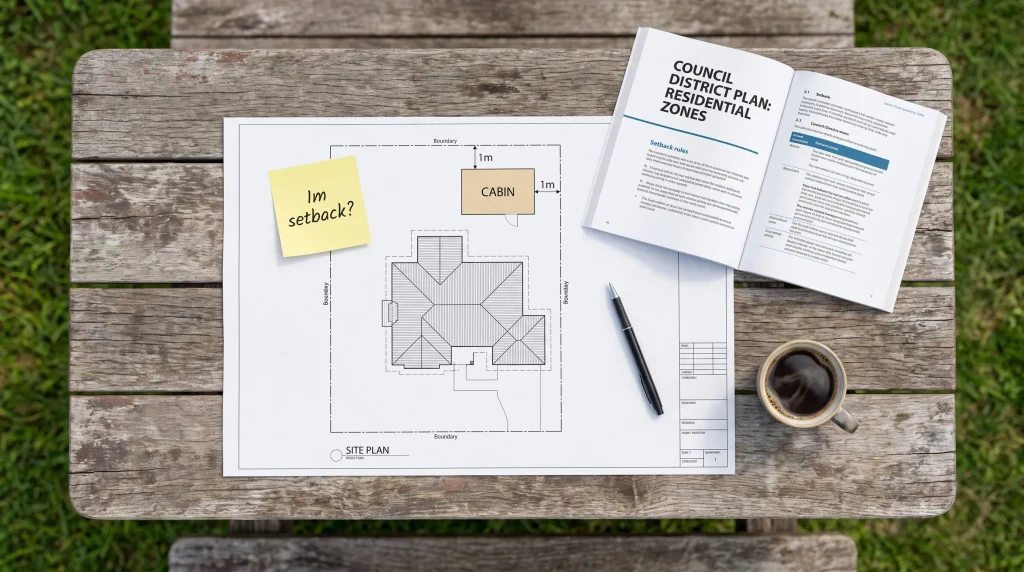
Resource consent is about where a structure sits and how it’s used, not how it’s built. It falls under the Resource Management Act and your council’s district plan. Boundary distances, how much of your section is covered by buildings, and what your zone allows all come under this heading.
Here’s what catches people out: the two are separate. A cabin can be exempt from building consent and still break a district plan rule, so check both.
Do I Need Council Consent to Rent a Portable Cabin in NZ?
In most cases, no. Small cabins with no kitchen, toilet or shower usually don’t need a full building consent in New Zealand, provided they meet the Schedule 1 exemption conditions. But the rules vary by council and by how the cabin is used. Always check with your local council before installation, as requirements differ across regions.
The Building Consent Exemptions That Cover Cabins
Schedule 1 of the Building Act lists low-risk building work that doesn’t need a building consent. Two parts of it matter for cabins. One covers buildings up to 10m². The other covers buildings between 10m² and 30m².
Cabins up to 10 square metres
This is the simplest exemption. It covers a single-storey detached building of up to 10m². Since the late-2025 changes, there’s no boundary setback condition for buildings this size. The building still can’t contain a toilet or store drinking water. If people sleep in it, it has to be used alongside a house and can’t have cooking facilities.
Room2rent’s Standard cabin (2.4m × 3.6m, about 8.6m²) sits in this band.
Cabins between 10 and 30 square metres
Bigger cabins can still be exempt, but they come with a few extra conditions. The design or build must be carried out or supervised by a Licensed Building Practitioner. Alternatively, it can be a kitset or prefabricated design that a Chartered Professional Engineer has designed or reviewed. The building must also:
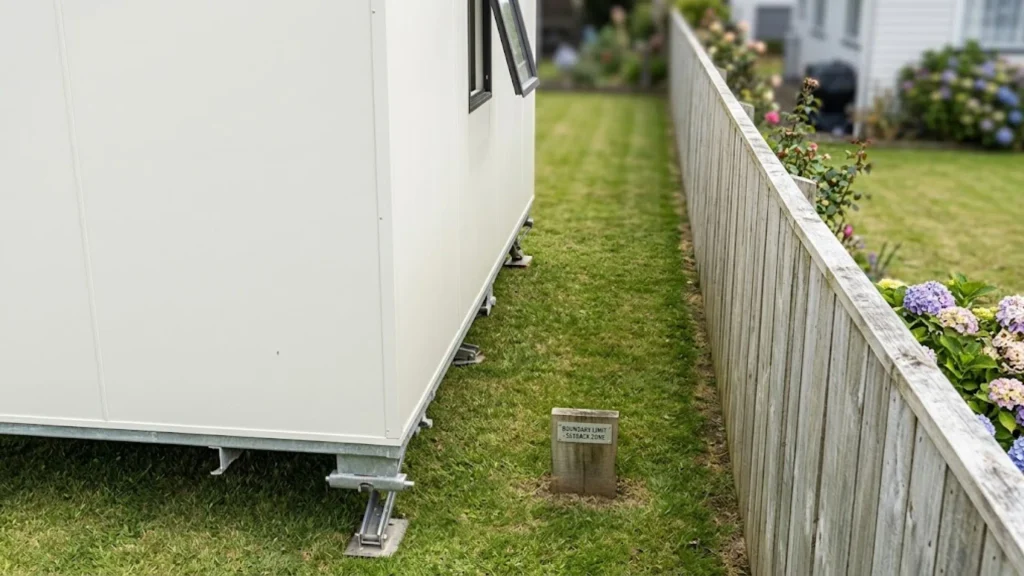
- sit at least 1 metre from any boundary or house
- stay single-storey
- have no toilet, shower or drinking-water storage
- have no cooking facilities if anyone sleeps in it
- have smoke alarms if it’s used for sleeping
Room2rent’s Large cabin (2.4m × 4.8m, about 11.5m²) and Extra Large cabin (3.0m × 4.8m, about 14.4m²) sit in this band. Ask your local team which exemption pathway your cabin uses before you ring the council.
| Room2rent cabin | Size | Floor area | Schedule 1 band | Main conditions to know |
| Standard | 2.4m × 3.6m | ~8.6m² | Up to 10m² | No toilet or cooking; used alongside a house if slept in |
| Large | 2.4m × 4.8m | ~11.5m² | 10–30m² | LBP or engineer-reviewed design; 1m setback; smoke alarms if slept in |
| Extra Large | 3.0m × 4.8m | ~14.4m² | 10–30m² | LBP or engineer-reviewed design; 1m setback; smoke alarms if slept in |
You can compare layouts on our cabins page or in our portable cabin size comparison. Still unsure? Here’s how to choose the right portable cabin.
What takes a cabin outside the exemption
Adding a kitchen or bathroom is the quickest way to lose the exemption. Once a cabin has its own cooking and washing facilities, it’s a self-contained dwelling, and a different set of rules applies. The same goes for connecting it to mains drainage, going over 30m², adding a second storey or placing it too close to a boundary.
One more thing to remember: exempt doesn’t mean rule-free. An exempt building still has to meet the Building Code. It just doesn’t need council sign-off to prove it.
Why Wheels Don’t Decide Whether You Need Consent
Many people think anything on wheels counts as a caravan and escapes the rules. It doesn’t. The Building Act’s definition of a “building” includes temporary and movable structures. A vehicle is also treated as a building once it becomes immovable and people live in it on a long-term basis.
Room2rent mobile cabins arrive on a trailer, but they don’t stay on wheels. Our delivery crew lowers four independent legs, levels the cabin, and then removes the wheels and drawbar. So what matters isn’t the wheels. It’s whether the cabin fits the Schedule 1 conditions above. If you’re thinking about living in a cabin full-time, raise that with your council too, because long-term use is part of how they assess things.
Resource Consent and Your District Plan
Even a cabin that’s exempt from building consent has to follow your district plan. District plan rules usually cover the following:
- Boundary setbacks. This is how far the cabin must sit from side boundaries, back boundaries and the road.
- Site coverage. This limits how much of your section can be covered by buildings.
- Height. Some zones have height limits, or rules about height near the boundary.
- Zone rules and overlays. Your zone and any flood, coastal or heritage overlays can add conditions.
If your cabin fits within the rules for a “permitted activity”, you won’t need resource consent. If it doesn’t, you might.
Rural zones usually give you more room than tight urban sections, which helps on a lifestyle block. On compact sections around Greater Wellington or smaller Kāpiti Coast sections, placement takes more care. Either way, a free call to your council’s duty planner can usually confirm whether your spot is a permitted activity.
Renting Your Cabin Out: What Changes
What matters is how the cabin gets used, not just its size. Here are the three most common setups.
Using it for your own household
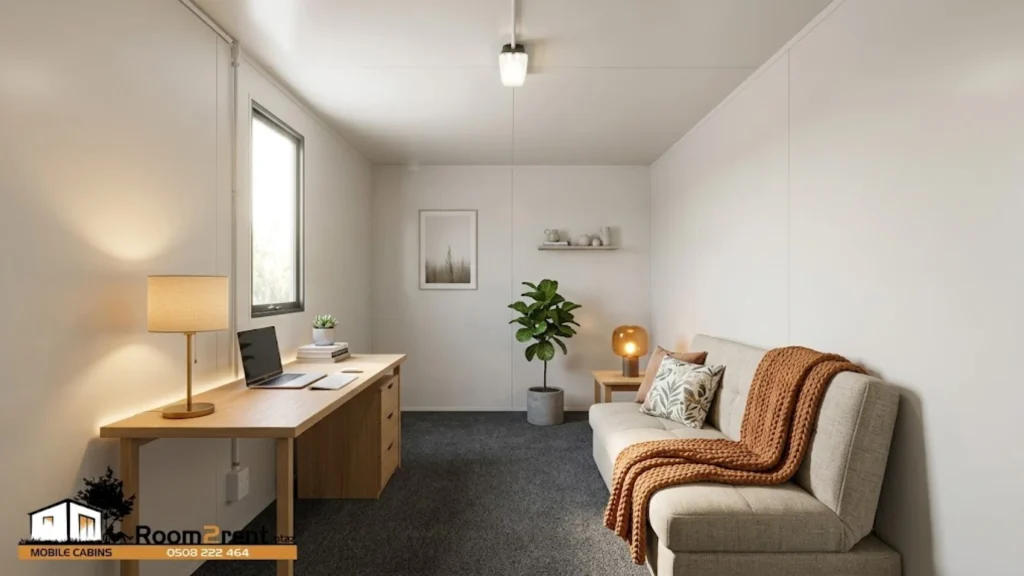
Using the cabin as a spare bedroom or teen retreat, space for visiting guests or a home office is the simplest case. The standard sleepout conditions apply, which you can read more about in our guide to renting a sleepout.
Renting it to a long-term tenant
If you let the cabin as part of a residential tenancy, the Residential Tenancies Act comes into play. So do the healthy homes standards, which cover heating, insulation, ventilation, moisture and draughts in rental properties. Room2rent cabins are insulated in the walls, ceiling and floor, which helps (see our cabin insulation guide and our winter heating tips). Even so, check with Tenancy Services how the standards apply to your exact setup.
Hosting short-stay paying guests
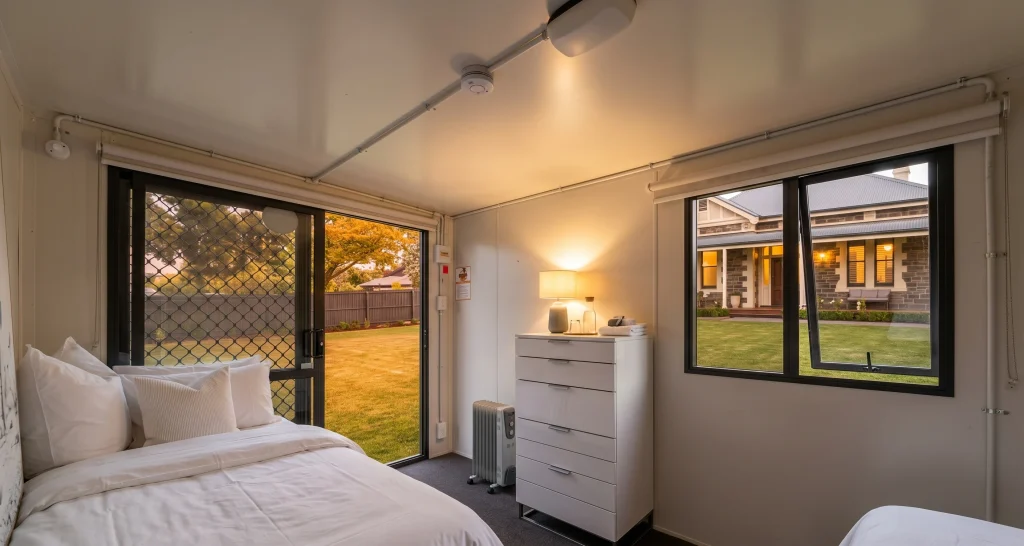
Some district plans treat regular paying guests as visitor accommodation. That can trigger a resource consent that a private sleepout wouldn’t need. Some councils also have their own rules for short-term rentals. If you’re thinking of listing your cabin online, read our cabin Airbnb guide. Then tell your council about the intended use up front, not just the cabin’s size.
The exemption for sleeping in a cabin assumes the cabin is used alongside a house, with guests using the main house’s kitchen and bathroom. If you’re really creating a separate home, you’ve moved into minor dwelling territory.
What the 2025–2026 Rule Changes Mean for Cabins
Two recent changes matter, but only one affects rented cabins.
In late 2025, MBIE simplified setbacks for small detached buildings, replacing the old rule that a building sit as far from the boundary as it was tall. Now there’s no setback condition for buildings up to 10m², and a flat 1-metre minimum applies between 10m² and 30m². This change does affect cabins.
From 15 January 2026, a new granny flat exemption allows self-contained standalone dwellings of up to 70m² without a building consent. The conditions are strict, including a Project Information Memorandum (PIM) before work starts, licensed builders and a 2-metre boundary setback. These rules are for building permanent dwellings, so they don’t change anything for a rented cabin without a kitchen or bathroom.
How Room2rent Helps With Consent Questions
Our local franchise owners talk through placement with every customer before any paperwork is signed. Using Google Maps, or a free site visit if access looks tricky, we check where the cabin will go, how the truck will get in and where the power will come from. We can also give you the cabin’s exact dimensions and confirm that it comes with an electrical certificate. Both are useful when you speak to your council. Our cabin rental FAQs cover the rest of the practical questions.
We can’t make the call for your council or give legal advice. The council has the final say, which is why we encourage you to check with them first.
Checking the Rules in Your Region
Your local council is the right place to confirm the rules, and every council runs a duty building or planning line. Here’s who to contact across Room2rent’s service areas.
| Room2rent region | Councils to contact | Local Room2rent page |
| Auckland | Auckland Council | Auckland West |
| Hamilton & Waikato | Hamilton City, Waikato District, Waipā District | Waikato & Hamilton |
| Rotorua & Bay of Plenty | Rotorua Lakes, Tauranga City, Western Bay of Plenty District | Rotorua & Bay of Plenty |
| Hawke’s Bay | Hastings District, Napier City | Hawke’s Bay |
| Taranaki & New Plymouth | New Plymouth District, Stratford District, South Taranaki District | Taranaki & New Plymouth |
| Taupō & Central Plateau | Taupō District, Ruapehu District | Taupō & Central Plateau |
| Whanganui & Rangitīkei | Whanganui District, Rangitīkei District | Whanganui & Rangitīkei |
| Manawatū & Palmerston North | Palmerston North City, Manawatū District | Palmerston North & Manawatū |
| Horowhenua | Horowhenua District | Horowhenua |
| Wairarapa | Masterton District, Carterton District, South Wairarapa District | Wairarapa, Masterton & Carterton |
| Kāpiti Coast | Kāpiti Coast District | Kāpiti Coast |
| Greater Wellington | Wellington City, Hutt City, Upper Hutt City, Porirua City | Greater Wellington |
| Nelson, Tasman & Marlborough | Nelson City, Tasman District, Marlborough District (Blenheim and Picton) | Nelson, Blenheim, Marlborough & Picton |
Key Benefits of Sorting Consent Before Delivery
A five-minute call to your council protects everything that comes after it. No surprise removal notices, no messy retrospective applications, and nothing odd on your LIM report when you sell. If you rent the space out, you’ll know from day one that you’re meeting the rules. Skipping this check is one of the most common portable cabin renting mistakes.
Every Room2rent cabin is single-storey, plumbing-free and under 30m², so you start from a strong position. That’s far easier than a custom build, a home extension or a full renovation.
Ready to Find Out What Fits Your Section?
You don’t have to work this out alone. Tell us your address and how you’ll use the cabin. Your local Room2rent team will talk you through placement, access and size before you commit to anything. You can request a free quote, check what a cabin costs, browse the full cabin range, or check that we cover your area on the regions page. If you’re new to renting, our step-by-step portable cabin rental guide walks you through the whole process, and you can see how fast we deliver.
Check Once, Place It Right: Final Thoughts on Cabin Consent
For most people, the answer is good news: a Room2rent cabin usually doesn’t need a building consent. What it does need is the right spot on your section, a clear idea of how you’ll use it, and a quick check with your council. Get those three things right and your cabin can be delivered, levelled and ready to use without any compliance surprises down the track.
How we checked this guide
On 28 September 2026 we checked this guide against MBIE’s Schedule 1 exemption guidance and its granny flat exemption guidance on building.govt.nz, Auckland Council’s granny flat exemption page, and Tenancy Services’ healthy homes information. We did not review each council’s district plan, because these differ and change over time. Consent rules are council-specific and subject to change, so always get confirmation from your own council, in writing where you can.
Frequently Asked Questions
Most rented cabins don’t need a building consent if they’re single-storey, under 30m², and have no kitchen, toilet or shower. They still have to follow your council’s district plan rules on boundaries, site coverage and zoning. Using the cabin for tenants or paying guests can add extra rules, so tell your council how you plan to use it before delivery. Checking early saves time and avoids surprises later.
You might need none. A small cabin with no kitchen or bathroom is usually exempt from building consent. You could need a resource consent if it breaks a district plan rule, or if your council treats paying guests as visitor accommodation. Long-term tenancies must also meet the healthy homes standards under the Residential Tenancies Act. Your council can confirm what applies to your address.
Your local council is the official source, and most councils run a free duty planner or duty building officer line. MBIE’s building.govt.nz site explains the national exemptions. Room2rent Mobile Cabins can talk you through our cabin sizes and placement, and a licensed building practitioner or planner can advise on complex sites. For most small cabins, the council call is enough.
Start with your district plan. Look up your zone and check the rules on setbacks, site coverage and visitor accommodation. If regular paying guests count as visitor accommodation in your zone, you may need a resource consent. Some councils also have short-term rental rules. Call your council’s duty planner, who can confirm what applies to your address. Get the answer in writing where you can.
First, check whether you need one at all, because most small cabins without plumbing are exempt. If you do need one, you apply through your council, usually online. You’ll need plans, specifications and the application fee. The council checks the design against the Building Code, inspects the work and then issues a code compliance certificate. Processing usually takes up to 20 working days.
It depends on the tiny home. If it has a kitchen and bathroom and sits permanently on site, it’s usually treated as a building, and it needs a consent or the 70m² granny flat exemption. A tiny home that stays a movable vehicle may not count as a building. Council rules on rental use still apply either way, so check with your council before you rent it out. Our tiny homes vs cabins guide explains the difference.
Yes. Any cabin used for sleeping should have working smoke alarms, and the 10–30m² exemption requires them. Electrical work must be safe and certified. Every Room2rent cabin comes with an electrical certificate. If you rent to a tenant, the healthy homes standards for heating, insulation, ventilation and moisture also apply. Tenancy Services has free checklists for landlords.
Your local council’s duty planner is the best first stop, and the advice is usually free. For harder cases, independent resource management planners can assess your site and prepare a consent application if you need one. Tenancy Services covers long-term rentals, and MBIE’s building.govt.nz site explains the building side. Start with the council, then bring in a planner only if you need one.
Licensed Building Practitioners, architects, draughtspeople and resource management planners all help with consent applications. You can search for LBPs on the public register at lbp.govt.nz. For a Room2rent cabin you usually won’t need one, because our cabins are designed to fit common exemptions. Talk to your council first, then decide if you need extra help.
Each council takes building and resource consent applications through its own website, often through an online portal. MBIE’s building.govt.nz is the official national guide. It explains the exemptions and includes a tool that helps you work out whether you need a consent. Search your council’s name plus “building consent” to find the right page and the online forms you need.