Creative Portable Cabin Uses in NZ: Ideas for Every Need
Want a Space That Does Something Different?
A portable cabin is a ready-made, insulated room that arrives by truck and sits on your property for as long as you rent it. Most people start with a desk or a spare bed. Then they realise it could be a sound booth, a warm potting room or a games room.
Here’s the honest bit. A cabin is one room, not a full home. It has no kitchen, no bathroom and no plumbing, and there are council rules about where it goes and how you use it. Inside those limits, the ideas are wide. This guide shares seven creative uses, the rules to check first, and what Room2rent customers really rent cabins for.
Beyond home offices and guest rooms, portable cabins work as sound rooms, garden studios, packing rooms, games rooms, playrooms, renovation bases and club rooms. Room2rent has three insulated sizes, delivery is usually within days, and rentals start at six months. Cabins with no kitchen or bathroom often qualify for a building consent exemption, but council planning rules still apply. A cabin is an extra room, not a full-time house.
Key Takeaways
- Cabins suit sound rooms, garden studios, packing rooms, games rooms, playrooms, renovation bases and club rooms.
- Room2rent has three insulated sizes: 3.6 m, 4.2 m and 4.8 m long.
- Rental terms start at six months, and delivery is usually within days.
- Room2rent covers much of the North Island and the top of the South Island.
- Cabins with no kitchen or bathroom often qualify for a building consent exemption, but district plan rules still apply.
- A cabin is an extra room, not a full-time home.
A Room2rent Cabin at a Glance
Every Room2rent cabin arrives ready to use. You get full thermal insulation, two double power outlets, LED lights inside and out, and a working smoke detector. There’s also an RCD switchboard with a certified electrical safety certificate and an outdoor security light. A 20-metre power cord plugs into a normal three-pin socket, so switching on is easy.
The three sizes are 3.6 m, 4.2 m and 4.8 m long, and all are 2.4 m wide and high. Rental starts at six months, depending on availability and region. In most cases, delivery and set-up take days, not months. Delivery costs about $150 to $350, and our pricing guide explains the rest. Compare sizes in our portable cabin size guide or on the Room2rent cabins page.
Looking for the everyday basics, like home offices and guest rooms? Our list of portable cabin uses covers those. This guide goes a step further.
What Can You Use a Portable Cabin for in New Zealand?
Portable cabins in NZ are most commonly used as home offices, sleepouts, creative studios, hobby workshops, pop-up business spaces and community meeting rooms. Room2rent cabins are delivered to your property on rental terms of six months or more and can be removed when you no longer need them.
Some of those uses already have their own guides, like turning a cabin into a hobby workshop and launching a small business from a backyard cabin. The ideas below are different. They’re the creative ones that most people don’t think of first.
Seven Creative Portable Cabin Ideas Beyond the Usual
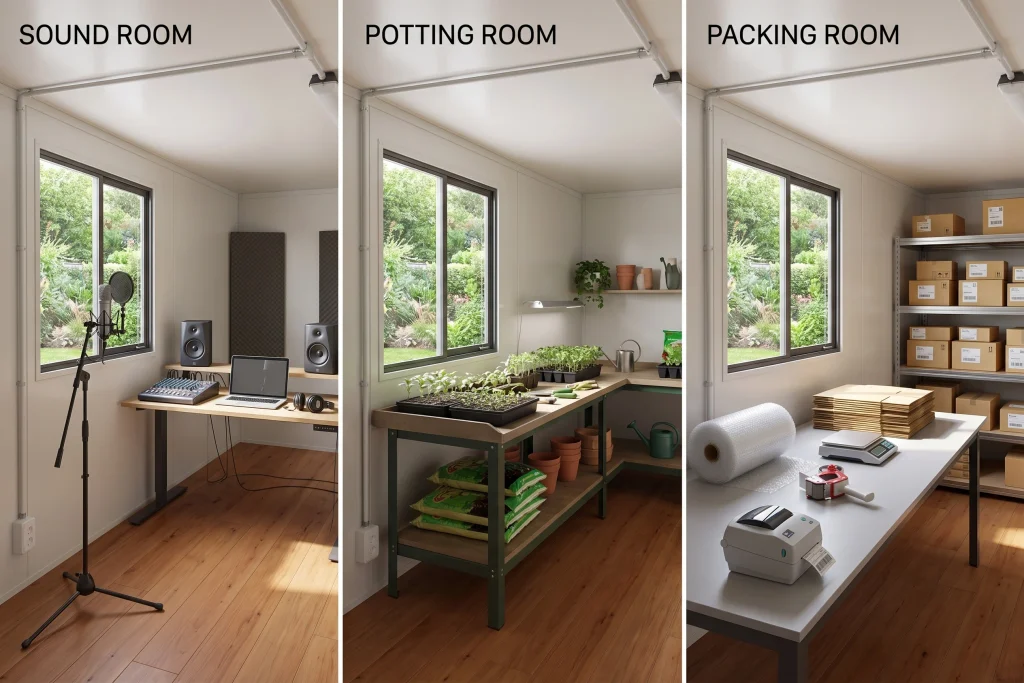
A Sound Room for Podcasts, Voice-Overs and Music Practice
A cabin gives loud or delicate sound a room of its own. Podcasters want quiet, and guitarists want somewhere to turn up. A cabin at the end of the garden keeps both away from the kids’ homework.
Be realistic about noise. Insulation softens outside sound, but a cabin isn’t soundproof. Rugs, heavy curtains and freestanding acoustic panels help. Ask us before you fix anything to the walls.
A Garden Studio and Potting Room
An insulated cabin gives seedlings and gardeners a steady, dry place to work. Start seeds in spring or keep tools and pots tidy all year. Because the cabin holds an even temperature, it’s kinder to plants than a draughty shed (see portable cabins versus garden sheds).
There’s no plumbing, so you’ll carry water in. Use trays under pots, and open a window often, because damp air builds up fast around plants. Our guide to preventing damp in a portable cabin explains how.
An Online Shop Packing Room and Photo Corner
A cabin turns a kitchen-table business into a proper dispatch room. Shelves hold your stock, a bench takes the parcels and a label printer lives on the desk. Near a window, you can set up a small photo corner for product shots.
Boxes and tape stay out of the house, and your family gets the dining table back. If couriers will visit often, check your council’s home business rules. Our portable office hire page shows how work setups can go.
A Games Room or Home Cinema
A cabin gives movie nights and gaming sessions a home away from the lounge. Add a projector, blackout blinds and a couple of beanbags, and you’ve got a cinema. Because it sits apart from the house, the noise stays outside your main living space.
A Large or Extra Large cabin fits a small sofa or floor seating. Keep the electrics simple, and see the power tips below.
A Playroom That Keeps the Toys Out of the Lounge
A playroom cabin gives small kids space to make a mess and gives you a calm house. Blocks and craft boxes can stay out all week, and kids play within sight of the kitchen window.
Keep it simple and safe. Use soft flooring, store heavy items low, and keep heaters well away from little hands. Adult supervision is a must.
A Base for Your Build or Renovation
A cabin works as a tidy project office while your home is a building site. Store plans and samples in one dry room, lock tools away overnight, and meet your builder somewhere dust-free.
The six-month minimum term suits a long renovation, and the cabin goes back when the work is finished. Our comparison of portable cabins versus renovations shows how the two can work together.
A Club or Committee Room
Clubs, small groups and community organisations use cabins as a simple meeting space. A table, some chairs and a whiteboard are all you need for a committee meeting or a planning session. If your group’s needs change, you can hand the cabin back at the end of your term.
There’s no plumbing, so a cabin can’t provide toilets or changing rooms. If the public will use it, ask your council about safety and access rules.
Before You Rent: Consent, Placement and Full-Time Living
Check the rules before you order. This is general information, not legal advice, and your council has the final say. Our guide to council consent for cabin rentals goes deeper.
Do You Need a Building Consent?
Often you don’t, but it depends on the size, the features and where the cabin goes. In NZ, “consent” means two things. Building consent checks that a building meets the Building Code. Resource consent is about where you put it, and it comes from your council’s district plan.
Schedule 1 of the Building Act 2004 lists small buildings that are exempt from building consent. Two paths matter most for cabins.
| Floor area | What the exemption needs |
| Up to 10 m² | Single-storey and detached, with no plumbing. A sleepout must be used with a house. |
| Over 10 m², up to 30 m² | Single-storey and detached. Design or supervision by a Licensed Building Practitioner, or a prefab design reviewed by a Chartered Professional Engineer. |
Both paths share conditions. There must be no kitchen, toilet or shower. If someone sleeps in it, it must be used with a house and have smoke alarms. It generally has to sit at least one metre from any boundary or residential building, and it still has to meet the Building Code.
By outside measurements, the Standard cabin covers about 8.6 m², under the 10 m² line. The Large (about 10.1 m²) and Extra Large (about 11.5 m²) sit just over it, so the wider 10 to 30 m² conditions may apply. Ask us which path fits your site, then confirm it with your council in writing. The official MBIE guidance on single-storey detached buildings up to 30 square metres sets it out clearly.
Even an exempt cabin must follow your council’s rules on setbacks, site coverage and height. A quick call to the planning team usually answers this.
Can You Live in a Portable Cabin Full-Time?
Usually not, at least not with a cabin set up the way ours are. The exemptions above don’t allow a kitchen, toilet or shower, and a cabin can’t work as a permanent home without them. Full-time living generally needs proper cooking and sanitary facilities, which usually means a consented dwelling.
New Zealand does have a separate granny flat exemption for self-contained homes of up to 70 m², but that’s a different building type with strict conditions. Think of your cabin as a room beside your main home, and speak to your council about anything more permanent.
Comfort, Power and Damp: A Reality Check
Warm in Winter, Cooler in Summer
Every Room2rent cabin has full thermal insulation, which is what keeps it comfortable. It slows heat moving through the walls, roof and floor, in winter and in summer.
It won’t do miracles, though, so on a scorching afternoon you’ll still want an open window or a fan. Our guides to how insulation works in NZ cabins and keeping your cabin cool in summer share practical tips.
Power and Heaters
Your cabin runs off a standard three-pin socket, so keep the load sensible. A heater, a lamp and a laptop are fine, and our winter heating guide has safe options. A projector, a big heater and a dehumidifier all at once may be too much, so ask the team first. Our power and water setup guide explains what to expect.
Where You Can Rent a Creative Cabin in NZ
Room2rent rents cabins across much of the North Island and the top of the South Island, through local franchise teams and contractors. Here’s where you’ll find us, with ideas that suit each area. Not sure who covers you? Check our regions page.
Auckland, Hamilton and Waikato
A backyard or lifestyle block has room for a garden studio or a packing room. We cover Auckland and Hamilton and Waikato. Read more about cabin rentals for Auckland backyards and cabins on Waikato lifestyle properties.
Rotorua, Bay of Plenty, Taupo and Central Plateau
A games room or club room adds space without changing the main house. We rent in Rotorua and Bay of Plenty and Taupo and the Central Plateau. See our guides to cabin delivery in the Bay of Plenty and Taupo cabin rentals.
Hawkes Bay, Taranaki and New Plymouth
A renovation base or a sound room works well on any spare patch of lawn. We cover Hawkes Bay and Taranaki and New Plymouth. Our Hawkes Bay cabin guide and New Plymouth work and living guide have local details.
Manawatu, Palmerston North, Rangitikei, Whanganui and Horowhenua
Lifestyle blocks here suit a garden studio or a playroom. We rent in Palmerston North and Manawatu, Rangitikei and Whanganui and Horowhenua. See our guide to cabins for Manawatu and Horowhenua lifestyle blocks.
Wairarapa, Masterton, Carterton, Kapiti Coast and Greater Wellington
Compact sections suit a small sound room or a project base, so plan placement early. We cover Wairarapa, Masterton and Carterton, the Kapiti Coast and Greater Wellington. Start with our guides to Kapiti Coast small sections and Wellington space solutions.
Nelson, Tasman, Blenheim, Marlborough and Picton
A garden studio or a packing room suits a lifestyle property in the top of the South Island. See our Nelson, Tasman, Blenheim, Marlborough and Picton cabin rentals and our guide to Nelson and Tasman lifestyle cabins.
Key Benefits of a Cabin for Creative Projects
A cabin gives your idea a home without a build.
| Benefit | What it means for you |
| Separate from the house | Noise, mess and clutter stay outside your living space |
| Ready when you are | Insulated, wired and lit, with delivery usually within days |
| Room to test an idea | Try a studio or shop for six months or more, without building |
| Easy to hand back | The cabin can be removed when your project ends |
Ready to Give Your Idea a Home?
Tell us what you want to try, and we’ll help you pick the right size. A quick chat is often all it takes. We’ll check your site, talk you through the rules, and explain delivery and terms.
You can contact Room2rent Mobile Cabins online, or call 0508 222 464. Prefer to look around first? See how to rent a portable cabin, browse our gallery of cabin setups, or read our FAQs page.
A Small Room With Big Ideas
A portable cabin is a simple way to give a big idea a small, separate home. Whether it becomes a studio, a games room or a project base, the best results come from planning. Pick the idea, choose the size, check the rules, and talk to people who’ve done it before.
Frequently Asked Questions
Beyond home offices, people use portable cabins as sound rooms, garden studios, online-shop packing rooms, games rooms, playrooms, renovation bases and club rooms. Room2rent cabins arrive insulated, wired and ready to use, and you can rent one for six months or more. Whatever your idea, check placement rules with your local council first, then talk to our team about which size suits you best.
Yes, with realistic expectations. Insulation softens outside noise, but a cabin isn’t a soundproof studio. Rugs, heavy curtains and freestanding acoustic panels all help reduce echo and sound leaking out. Ask Room2rent before you fix anything to the walls. Placing the cabin away from neighbours’ fences will make a big difference to how loud you can practise without upsetting anyone nearby.
Yes. The insulation helps keep the room at a steadier temperature than a draughty shed, which suits seedlings and tools. There’s no plumbing, so you’ll carry water in and use trays under pots. Open a window often, because damp air builds up quickly around plants. Ask the team about your plans so they can suggest the best position on your section, ideally somewhere with good morning light.
Yes. A cabin makes a dry, lockable project office for plans, samples and tools while your home is being worked on. Room2rent’s minimum rental is six months, depending on availability and region, which suits a longer renovation. Check placement rules with your council, and confirm whether your builder needs anything specific, like power access or a clear delivery route for the truck.
Yes, many people use a cabin as a packing and dispatch room. Add shelves, a packing bench and a label printer, and you can keep stock out of the house. A window helps if you want a small photo corner for product shots. If couriers will visit often, or customers will collect goods, check your council’s home business rules before you start, and tell them how the space will be used.
Yes. A Large or Extra Large cabin has room for a screen or projector, blackout blinds and some floor seating. Because it sits apart from the house, the noise stays outside your main living space. Keep the electrics simple, since the cabin runs from a standard three-pin socket, and ask the team before you plug in several large appliances together. A small fan or heater is usually fine for a cosy evening.
Yes, but ask first. Freestanding shelves, rugs, curtains and furniture are all fine (our smart styling ideas help) and won’t damage the walls. Before you drill, screw or glue anything into the cabin, check with Room2rent so you don’t affect the insulation or the wiring. Removable hooks and adhesive strips are a good way to hang lightweight items, and a rug or lamp will make the room feel like yours.
Usually yes, in moderation. Every cabin has two double power outlets and connects to a standard three-pin socket, so plan your load carefully. A small heater and a dehumidifier suit many hobby setups (see our winter heating guide), but a projector, big heater and dehumidifier together may be too much. Ask the team before you run several larger appliances, so nothing trips or overloads, especially in winter.
Not usually. Building consent exemptions don’t allow a kitchen, toilet or shower, and full-time living generally needs those facilities plus a consented dwelling. Room2rent cabins work best as extra rooms next to a main home. If you want something more permanent, talk to your council first about what’s allowed on your property, and ask about the granny flat rules for self-contained homes.
Some can. Anything involving food preparation, plumbing, paying guests or public use may trigger extra rules, even if the cabin itself is exempt from building consent. Your district plan can also limit home businesses, noise and site coverage. Tell your council exactly how you plan to use the cabin, not just its size, and ask them to confirm their answer in writing.