Top 5 Benefits of Renting a Portable Cabin vs Building an Extension
Out of Room and Out of Patience?
The house felt fine when you moved in. Then the kids got bigger, work moved home, or whānau needed somewhere to stay. Now every room is doing two jobs, and the kitchen table has become a desk, a homework station and a laundry pile all at once.
Most Kiwi families think “extension” first. It feels like the grown-up answer. But when the quotes arrive, the price, the wait and the paperwork can take your breath away. That’s why so many households, from Auckland to Picton, are asking a simpler question: could renting a portable cabin do the same job for a fraction of the cost?
A small home extension in New Zealand typically costs $80,000 to $120,000 and takes 4 to 7 months to build once work starts, plus design and consent time. Renting a Room2rent portable cabin usually costs $85 to $220 a week, arrives within days, and most small cabins don’t need a building consent. If you need space now, and you’re not sure you’ll need it forever, renting is faster and far cheaper. If you need a permanent room with plumbing that adds value to your home, an extension may be worth it.
Key Takeaways
- A small NZ extension costs about 80,000–120,000 and 4–7 months of building in 2026.
- Renting a Room2rent cabin costs about 85–220 a week and arrives within days.
- Small cabins usually don’t need building consent, but check placement with your council.
- Insulated cabins stay comfortable year-round with a small heater.
- Choose an extension if you need plumbing or permanent, value-adding space.
- Room2rent delivers across 13 service regions, from Auckland to Picton.
What Renting vs Building Really Means for You
Renting a portable cabin vs building an extension is really a choice between flexible space now and permanent space later. An extension adds square metres to your house for good. A rented cabin gives you a warm, private, separate room in your backyard for as long as you need it, and then it goes back.
This guide focuses on the renting side of that choice. We’ll cover real 2026 costs, the five biggest benefits of renting, how the decision plays out in each region we serve, what councils may ask for, and when an extension is honestly the better call. If time matters most, our portable cabins vs home extensions timeline guide shows how many weeks each option takes, stage by stage.
Is Renting a Cabin Cheaper Than Extending Your House?
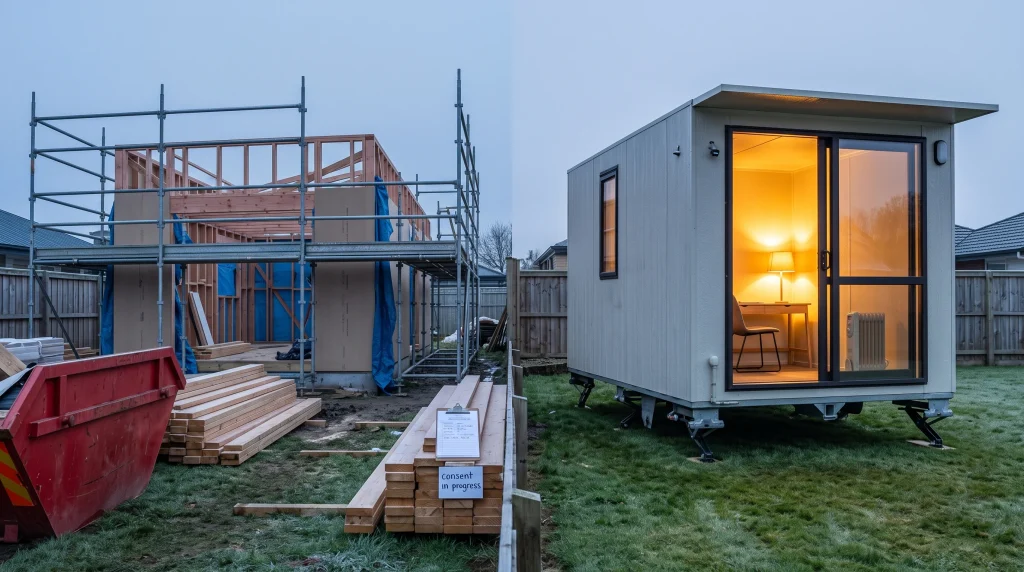
Yes, in almost every short-to-medium-term case. A small 15–25m² extension in New Zealand costs around 80,000–120,000 in 2026, while renting a Room2rent cabin costs about 85–220 a week, with most households paying 110–170, so even two full years of rent usually costs less than a fifth of a small extension.
What Each Option Costs in 2026
Extensions cost more per square metre than most people expect, while cabin rent stays small and predictable. Here’s how the two compare for a typical single-room need, like a bedroom or home office.
| Building an extension | Renting a Room2rent cabin | |
| Typical cost | 80,000–120,000 for 15–25m² | 85–220 per week |
| Upfront spend | Deposit, design and consent fees | Delivery and bond, then weekly rent |
| Time to use | 4–7 months of building, plus design and consent | Usually days once booked |
| Building consent | Required for added floor area | Usually not needed for small cabins |
| Disruption | Builders, noise and dust at home | Delivered and placed in a few hours |
| Flexibility | Permanent | Minimum 6-month term, then return it |
| Adds property value | Often, if done well | No |
The Real Price of an Extension
A small extension still runs well into six figures once everything is added up. According to Builders Near Me NZ’s 2026 extension cost guide, home extensions in New Zealand cost $2,500 to $4,500 per square metre, and a small extension of 15 to 25 square metres costs $80,000 to $120,000. The same guide puts a standard build at 4 to 7 months from the day construction begins.
That figure is often just the build. Add Value Renovations notes that design and consent documentation adds roughly 8–12% of the build cost on top. Their national guide also says Auckland sits at the top of the range, with other regions typically 10–20% lower. So a quote in Palmerston North or Nelson may land a little under one in West Auckland, but you’re still looking at tens of thousands of dollars before anyone moves in.
The Real Price of Renting
Renting spreads the cost into a weekly amount you can plan around. Room2rent’s 2026 pricing guide puts weekly rates at $85 to $220, depending on cabin size, insulation and your location. Most households land between $110 and $170 a week for a standard insulated cabin.
Delivery, any power work and bond are priced separately, so ask for a total cost for your whole rental term, not just the weekly rate. To picture it, a cabin at $170 a week for a full year costs about $8,840. You’d need to rent for roughly nine years before you spent what a small $80,000 extension costs on day one.
The Top 5 Benefits of Renting a Portable Cabin
1. You Keep Your Savings Where They Are
Renting turns a huge lump sum into a small weekly cost. Instead of borrowing $80,000 or more, you pay a weekly rate you can budget for, just like a phone plan or a power bill. Your savings stay put for the things that matter, and you don’t add a big top-up to your mortgage. For more on how this adds up over time, see our look at the financial benefits of long-term cabin hire.
2. You Get Your Space in Days, Not Months
A cabin arrives ready to use, so the wait is short. There’s no design stage, no months of builders and no living in a building site. On delivery day, the cabin is towed in, levelled and plugged in, often within a few hours. Our delivery process guide shows exactly what happens on the day.
3. Your Home Stays Calm and Clean
The cabin goes in the backyard, so your house is never torn open. No dust in the kitchen, no strangers in the hallway, no tarps on the roof when the weather turns. Your family can carry on with normal life while the new space simply appears out the back.
4. You Aren’t Locked In Forever
When your needs change, the cabin goes back. Room2rent’s minimum rental term is usually six months, depending on availability and your area. After that, you can keep it, swap to a different size or return it. An extension can’t be handed back when the teenager leaves home or you move house.
5. One Cabin, Many Jobs
A cabin can change roles as your life changes. It might be a home office this year and a teenager’s room next year. It could host grandparents for a season or become a quiet studio. If work is the main reason, our guides to setting up a cabin home office for remote work and getting your cabin online will help. For more ideas, see our top 10 uses for portable cabins.
How the Choice Plays Out Across Our Regions
The basic maths is the same everywhere, but local life shapes why people rent. Auckland extensions tend to cost the most, while sections, weather and work patterns vary from region to region. Here’s a quick guide to each area Room2rent covers, with a link to its local page.
| Region | Why households often rent instead of build |
| Auckland West | Extension costs sit at the top of the national range, and many sections are tight |
| Waikato and Hamilton | Growing families and lifestyle blocks with room out the back |
| Rotorua and Bay of Plenty | Multi-generational households and whānau staying for a season |
| Hawke’s Bay | Seasonal work and short-term space needs |
| Taranaki and New Plymouth | Home offices and work-related accommodation |
| Taupō and Central Plateau | Cold winters, where a warm, insulated room matters |
| Whanganui and Rangitīkei | Rural properties that need flexible extra space |
| Manawatū and Palmerston North | Students, young families and study space |
| Horowhenua | Lifestyle blocks and growing households |
| Wairarapa, Masterton and Carterton | Hybrid workers commuting to Wellington who need a proper office |
| Kāpiti Coast | Smaller coastal sections where building out is tricky |
| Greater Wellington | Compact, sloping sections and high building costs |
| Nelson, Tasman, Blenheim, Marlborough and Picton | Tight rental markets and seasonal vineyard work |
Not sure if we reach your address? Check the full list on our regions page.
What Councils Usually Ask For
Most small portable cabins don’t need a building consent, but an extension almost always does. The Citizens Advice Bureau explains that a small detached sleepout or cabin up to 10 square metres may not need building consent. A sleepout is linked to your main home and relies on it for the bathroom, laundry and cooking. Larger cabins up to 30m² can also be exempt when certain design conditions are met. Room2rent’s cabins range from about 8.6m² to 11.5m², with no kitchen or bathroom, which keeps them well inside these limits.
An extension is different. Builders Near Me NZ notes you must get council consent for any extension that adds floor area to your home. That’s one reason extensions take so long before a hammer is even lifted.
Even when a cabin doesn’t need building consent, your district council’s plan may still have rules on boundary distances and how much of your section is covered by buildings. These differ between councils, so a quick call to your council’s duty planner before delivery is always worth it. Our council consent guide explains exactly what to ask.
Will a Cabin Keep You Comfortable All Year?
Yes, as long as it’s properly insulated and you heat it sensibly. New Zealand’s weather varies a lot, from frosty mornings on the Central Plateau and in the Wairarapa to strong winds in Wellington and on the Kāpiti Coast. Room2rent cabins are insulated in the walls, ceiling and floor, so a small heater can keep the space warm without huge power bills.
Because a cabin is small, it heats up quickly. Good airflow matters too, especially when someone sleeps in it every night. Our guides on cabin insulation, winter heating options, preventing damp and cabins in windy zones walk you through the details.
When an Extension Is the Better Call
An extension makes more sense when you need the space permanently and want it to add value to your home. We’d rather you choose the right option than the one we rent, so here’s where building usually wins.
If you need a bathroom, a kitchen or plumbing in the new room, a rented cabin isn’t the right fit. If you plan to stay in your home for ten years or more and the space will be used every day, the long-term maths starts to lean towards building. And if you’re planning to sell, a well-built extension can lift your property’s value, while a rented cabin leaves with the rental.
For most other situations, a growing teenager, a home office, a season of visiting whānau or a “we’re not sure yet” need, renting gives you the room now and keeps your options open.
How Renting a Cabin Works
Renting a cabin is a short, simple process. First, pick a size. Our size comparison guide helps you match the cabin to how you’ll use it. Next, check the spot on your section. You need a flat area and a clear path for the delivery trailer.
Then confirm any council questions, book your delivery date, and plug the cabin into a standard outdoor power point. Our step-by-step rental process covers each stage.
Get Your Free Cabin Quote
The fastest way to decide is to put a real cabin quote next to your extension quote. Browse the Room2rent cabin range, look through real setups in our photo gallery, then request a quote for your address. Tell us what you need the space for, and we’ll help you choose the right size and give you a clear total cost for your whole rental term.
Space Now, Choices Later
Renting a portable cabin vs building an extension isn’t about which is “better”. It’s about what your family needs right now. If you need a permanent room with plumbing and you plan to stay for the long haul, an extension can be a smart investment.
But if you need extra room this season, for a teenager, a home office or whānau who’ve come to stay, renting a cabin gets you there in days, keeps your savings intact and lets you change your mind later. For most Kiwi families, that flexibility is worth a lot. When you’re ready, get a quote from Room2rent and see what a cabin could look like on your section.
Frequently Asked Questions
Renting a cabin is cheaper, faster and flexible. You pay weekly, it arrives within days and small cabins rarely need building consent. The downside is it doesn’t add value to your home and has no plumbing. An extension adds lasting value and can include a bathroom, but costs $80,000 or more and takes months. Choose based on how long you need the space and what needs to go in it, like plumbing.
A small portable cabin in New Zealand usually rents for about $85 to $120 a week. Mid-size insulated cabins used as bedrooms or offices sit around $120 to $170 a week. Delivery, bond and any power work are usually charged on top. Your exact price depends on size, insulation, your region and rental length, so ask for a written total cost for the whole rental term before you book anything at all.
Several companies rent cabins to homeowners in New Zealand. Room2rent delivers across 13 regions, from Auckland and Waikato down to Wellington, Nelson, Marlborough and Picton. When you compare providers, check weekly rates, delivery fees, insulation, minimum rental terms and local reviews, and ask each one for a written quote that includes every single cost, including delivery.
An extension is a large upfront cost, often $80,000 to $120,000 for a small room, but it can add value to your home. Renting has no big upfront cost and no lasting value. At about $170 a week, a cabin costs around $8,840 a year, so it takes roughly nine years to match a small extension. If your need is short-term or still uncertain, renting usually wins on the money side by a wide margin.
Renting a portable cabin costs about $85 to $220 a week in New Zealand, with most families paying $110 to $170. Building a small 15–25m² extension costs about $80,000 to $120,000 in 2026, before design and consent fees. That means two full years of cabin rent is usually still far less than a small extension costs on its first day. Delivery and bond are extra, so ask for a full total quote.
Most small portable cabins in Auckland don’t need a building consent, especially when they have no kitchen or bathroom and stay within the size limits for exempt sleepouts. However, Auckland Council’s Unitary Plan has rules on boundary distances and site coverage. Before your cabin arrives, check your zone rules or call Auckland Council, and confirm in writing that your chosen spot is allowed.
Start with Google reviews on each company’s Business Profile, which show recent feedback from local customers. Facebook pages and community groups in your town are also useful for honest opinions. Ask the rental company for references from customers in your area, and look at photo galleries to see real setups rather than only polished marketing images from ads.
A standard home extension in New Zealand, including Christchurch, usually takes 4 to 7 months once building starts. Before that, you need time for design, quotes and building consent, which can add weeks or months. Builder availability can also delay start dates. Room2rent currently delivers cabins in the North Island and the top of the South Island, not Canterbury, so check your region first.
Portable cabins are the fastest way to add living space. Once you’ve booked and checked your site, a cabin is usually delivered, placed and plugged in within a few hours on the day. An extension needs design, council consent and 4 to 7 months of building. If you need a bedroom or office in the next few weeks, renting a cabin is the quickest option by a long way, with far less stress.
Room2rent offers portable cabin rentals for homes across Greater Wellington, the Kāpiti Coast and the Wairarapa. You can check delivery areas on the Room2rent Greater Wellington region page and request a quote online. It’s also worth comparing a couple of providers on price, insulation, wind rating, delivery fees and minimum rental terms before you make your final choice.